
Preventing High-Temperature Demagnetization in Halbach Array Rotors: Material Selection and Engineering Safeguards
Specify high-coercivity NdFeB, thermal safeguards, and RFQ tests to prevent Halbach rotor demagnetization in high-temperature electric motor programs.
For high-temperature Halbach rotor demagnetization risk, material selection cannot be separated from thermal modeling, magnet segmentation, adhesive qualification, and supplier validation. This guide is written for motor engineers, sourcing teams, and program managers deciding whether a proposed Halbach array rotor can survive high-RPM electric motor service.
If your team is still comparing planar, cylindrical, and arc-segmented builds before the thermal review, start with our Halbach magnet assembly sourcing guide, then use this page as the rotor-specific demagnetization checklist. For drawing-level feedback, contact the engineering team with rotor OD/ID, pole count, peak speed, duty cycle, cooling method, target air-gap flux, and expected peak magnet temperature.
The push for electrification across automotive, advanced mobility, and industrial robotics has driven electric motor design to its physical limits. To achieve higher torque density and efficiency without drastically increasing weight, engineers consistently turn to the Halbach array. By manipulating the magnetic flux to be almost entirely concentrated on the working side (facing the stator) and canceled on the shielded side, a Halbach rotor can deliver exceptional performance while eliminating the need for heavy ferrous back-irons.
However, the very geometry that gives the Halbach array its power also makes it uniquely vulnerable. In high-speed, high-power motors, thermal management is a critical failure point. When you combine the intense heat generated by stator windings and eddy currents with the continuous, internal repulsive forces inherent to a Halbach configuration, the risk of irreversible demagnetization skyrockets.
For engineering managers and procurement teams sourcing magnetic assemblies, misunderstanding the thermal dynamics of a Halbach array can lead to permanent torque loss, rejected prototypes, or field failures. This guide breaks down the precise mechanisms of thermal demagnetization in Halbach configurations, provides a strict framework for specifying Neodymium Iron Boron (NdFeB) grades, and outlines the mechanical safeguards needed before release.
Scope, Assumptions, and Limits
This review was last checked on June 23, 2026. It applies to NdFeB and SmCo magnet selection for high-speed radial flux, axial flux, and BLDC-style Halbach rotors where the magnets see elevated temperature, high electrical frequency, centrifugal stress, and internal demagnetizing fields.
It does not replace project-specific electromagnetic FEA, thermal FEA, spin testing, adhesive qualification, or supplier-provided second-quadrant B-H curves at temperature. The derating values below are procurement screening values, not certified survival limits. Low-speed room-temperature fixtures, planar holding arrays, and demonstration Halbach rails usually do not need the same UH/EH/AH-grade safeguards.
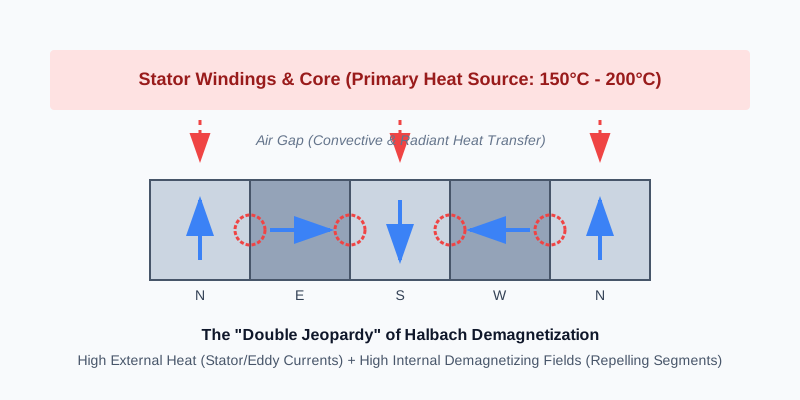
The "Double Jeopardy" of Halbach Demagnetization
To understand why Halbach arrays are so sensitive to temperature, you must understand the operating point of a magnet on its B-H (demagnetization) curve. Permanent magnets are not static; their ability to resist losing their magnetism is heavily dependent on both temperature and external magnetic fields.
In a standard dipole rotor assembly, the magnets are generally arranged with alternating north and south poles facing outward. They operate in a relatively stable magnetic circuit.
A Halbach array, conversely, forces magnets into highly unnatural orientations. Adjacent magnets are positioned such that their magnetization vectors are rotated—often by 90 degrees or 45 degrees. This creates a scenario where the magnets are constantly exerting massive repulsive forces against one another. From a magnetic physics perspective, each magnet segment is continuously subjected to a strong internal demagnetizing field generated by its neighbors.
The Impact of Heat on Coercivity
This internal demagnetizing field pushes the operating point of the magnet lower on the B-H curve. Under room temperature conditions, a standard NdFeB magnet has enough intrinsic coercivity (Hcj) to withstand this internal pressure.
However, as temperature rises, coercivity drops dramatically. In a high-speed brushless DC (BLDC) or axial flux motor, heat is generated rapidly through:
- I^2R Losses (Copper Losses): Resistance in the stator windings generates immense heat, which radiates across the air gap to the rotor.
- Eddy Current Losses: High-frequency magnetic switching induces eddy currents directly within the conductive NdFeB magnets themselves, causing them to heat up from the inside out.
When the operating temperature approaches the magnet's limits, the combination of thermal degradation and the continuous internal repelling field of the Halbach array creates a "double jeopardy" scenario. If the operating point dips below the "knee" of the B-H curve, the magnet suffers irreversible demagnetization. Even when the motor cools down, a permanent loss of flux remains, resulting in a permanent loss of motor torque and efficiency.
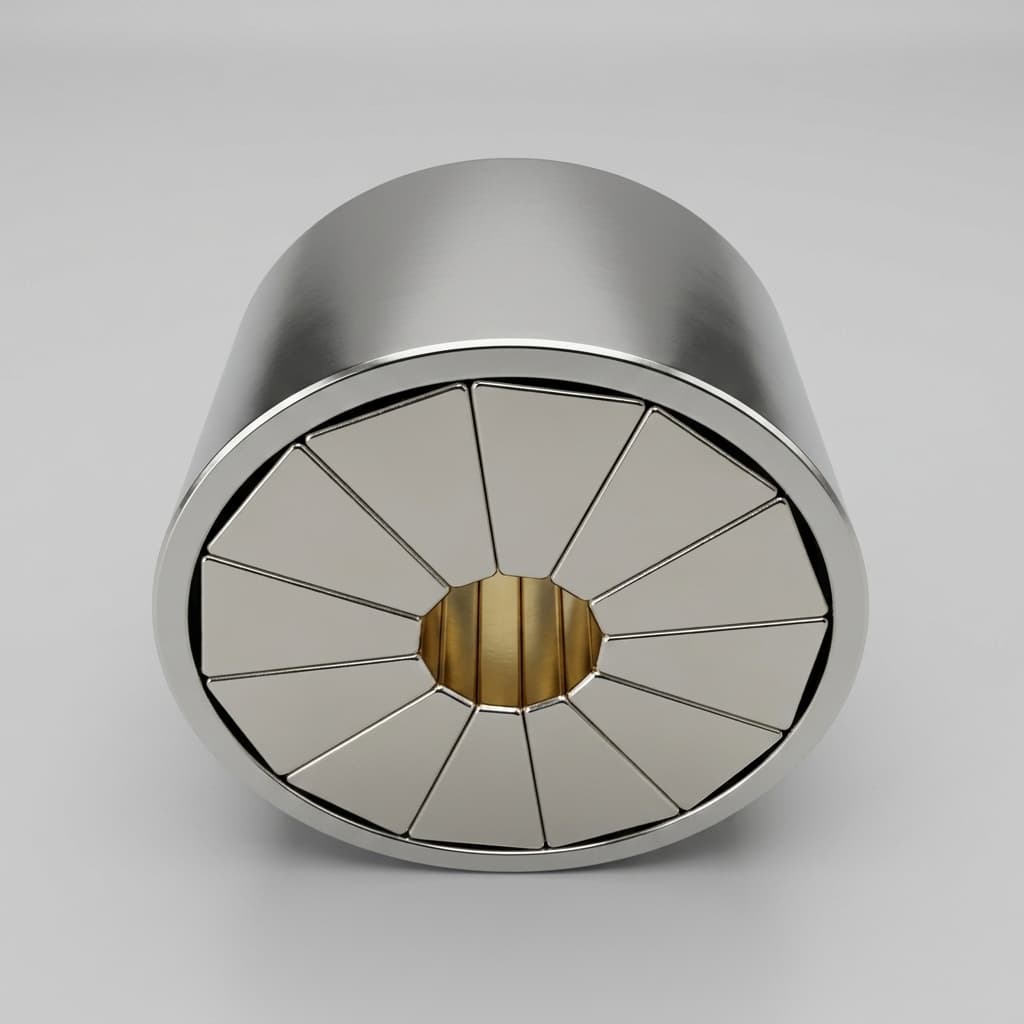
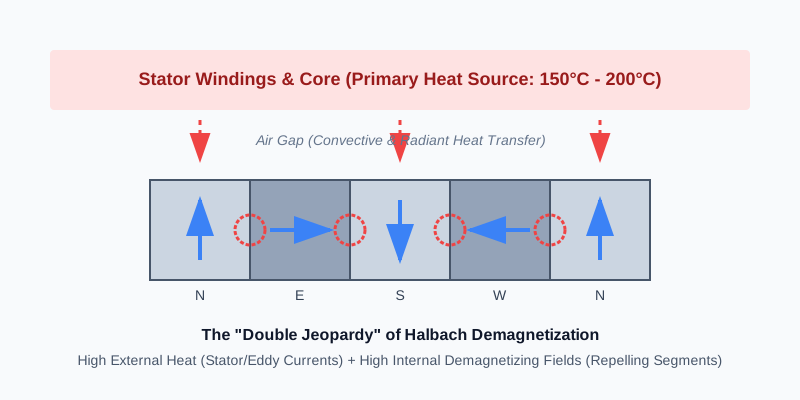 Figure 1: Thermal transfer paths and internal demagnetizing fields in a standard 90-degree Halbach array configuration.
Specifying High-Coercivity NdFeB for Halbach Rotors
Standard neodymium magnets, such as N42 or N52, are entirely unsuitable for Halbach motor applications due to their low temperature tolerance (typically failing around 80°C). To survive the thermal environment of an electric motor, procurement teams must specify high-temperature grades characterized by the suffix letters in their naming convention (e.g., SH, UH, EH, AH).
These higher temperature grades are achieved by alloying the NdFeB with heavier rare earth elements, primarily Dysprosium (Dy) or Terbium (Tb). While these elements drastically increase the intrinsic coercivity (Hcj) and temperature resistance, they also come with a trade-off: they slightly reduce the overall remanence (Br, or total magnetic strength) and significantly increase the raw material cost.
Grade Selection Matrix for Motor Sourcing
The following table outlines the practical application limits for various NdFeB grades specifically when used in Halbach array topologies. Note that the "Maximum Operating Temperature" often cited on standard specification sheets must be derated when the magnet is deployed in a Halbach array due to the internal demagnetizing fields.
| Grade Suffix | Typical Max Temp (Dipole) | Derated Max Temp (Halbach) | Min. Intrinsic Coercivity (Hcj) | Primary Motor Applications | Relative Cost Premium | Heavy Rare Earth (Dy/Tb) Content | Susceptibility to Demag in Halbach | Sourcing Lead Time Impact |
|---|---|---|---|---|---|---|---|---|
| None (e.g., N52) | 80°C | Not Recommended | $\ge$ 12 kOe | Consumer electronics, sensors | Baseline | Lowest | Extreme Risk | Standard (Fast) |
| M (e.g., N48M) | 100°C | 75°C | $\ge$ 14 kOe | Low-speed actuators, fans | +10% | Low | High Risk | Standard |
| H (e.g., N45H) | 120°C | 95°C | $\ge$ 17 kOe | Industrial servos, pumps | +25% | Moderate | High Risk | Standard |
| SH (e.g., N42SH) | 150°C | 125°C | $\ge$ 20 kOe | E-bikes, standard EV traction | +40% | High | Moderate Risk | Moderate |
| UH (e.g., N38UH) | 180°C | 150°C | $\ge$ 25 kOe | High-performance EV and advanced mobility | +75% | Very High | Low Risk | Extended |
| EH (e.g., N35EH) | 200°C | 175°C | $\ge$ 30 kOe | Extreme environment, motorsport | +120% | Exceptional | Minimal Risk | Highly Extended |
| AH (e.g., N33AH) | 230°C | 200°C | $\ge$ 35 kOe | Downhole drilling, extreme environment systems | +200% | Maximum | Negligible Risk | Custom Only |
| SmCo (Samarium) | 300°C+ | 300°C+ | Variable | Extreme heat and high-reliability systems | +300% | N/A (Cobalt based) | Negligible Risk | Custom Only |
Note: The derated temperatures for Halbach configurations are approximate and depend heavily on the specific aspect ratio of the magnet segments and the precise permutation angle (e.g., 45-degree vs 90-degree).
For procurement workflows, treat this matrix as the first gate. If a supplier quotes a standard N52 or N48 grade for a compact high-RPM rotor, move the program back to engineering review before comparing price. If the supplier proposes UH, EH, AH, or SmCo, ask for the exact grade datasheet, temperature-specific B-H curves, coating stack, magnetization tolerance, and a statement of whether Grain Boundary Diffusion was used.
Engineering Safeguards Beyond Material Selection
While specifying an EH or AH grade of neodymium is the first material safeguard, material selection alone is not enough. The mechanical and structural design of the rotor assembly must actively work to mitigate thermal buildup and protect the magnets.
1. Segmentation to Reduce Eddy Currents
As mentioned, eddy currents induced by high-frequency magnetic flux switching will heat the magnets internally. Because NdFeB is electrically conductive, large solid blocks of magnet will generate massive eddy currents.
To prevent this, the individual magnet segments in the Halbach array should be further subdivided (sliced) along the axial length of the rotor. These slices are then bonded back together using a high-temperature, electrically insulating epoxy. This segmentation breaks the electrical path, drastically reducing the volume of the eddy currents and, consequently, the internal heat generation.
2. High-Temperature Bonding and Encapsulation
The structural integrity of a Halbach array relies almost entirely on the adhesives holding the repelling segments together. If the temperature exceeds the Glass Transition Temperature (Tg) of the epoxy, the adhesive will soften. In a high-speed rotor, a softened epoxy will lead to the magnets shifting or violently detaching under centrifugal and repulsive magnetic forces.
Engineers must specify industrial-grade epoxies with a Tg well above the maximum anticipated operating temperature of the motor. Furthermore, total encapsulation—often via a carbon fiber sleeve or a thin titanium retaining ring—is mandatory for high-RPM applications to provide mechanical containment independent of the adhesive.
3. Grain Boundary Diffusion (GBD) Technology
For procurement teams struggling to balance the high cost of Dysprosium with the need for high coercivity, Grain Boundary Diffusion (GBD) is a critical manufacturing process to explore.
In traditional manufacturing, Dysprosium is mixed evenly throughout the entire magnet. However, demagnetization typically starts at the surface edges of the magnet. GBD technology involves diffusing Dysprosium only into the outer "shell" (the grain boundaries) of the magnet after it has been sintered. This creates a magnet with an incredibly high coercivity at the surface—exactly where it is needed most to resist the internal Halbach repulsions—while using significantly less heavy rare earth material, thereby preserving the high remanence (Br) of the core and lowering the cost.
Safeguard Selection Matrix
Use the following matrix when converting thermal risk into RFQ language. It keeps the discussion specific enough for Product Engineering review and prevents suppliers from answering with a generic "high-temperature magnet" quote.
| Risk Trigger | Default Engineering Safeguard | Supplier Evidence to Request |
|---|---|---|
| Peak magnet temperature above 120°C | SH grade minimum, UH preferred for compact rotors | B-H curves at 20°C, 100°C, 120°C, and peak temperature |
| Peak magnet temperature above 150°C | UH/EH grade or SmCo trade study | Grade certificate plus irreversible loss estimate after heat soak |
| High electrical frequency or high pole count | Axial magnet segmentation with insulating bond lines | Eddy-current loss calculation and segmentation drawing |
| Speed above 10,000 RPM | Carbon fiber, titanium, Inconel, or non-magnetic sleeve | Hoop-stress calculation and overspeed test plan |
| Epoxy close to service temperature | Adhesive with Tg at least 30°C above peak temperature | Adhesive datasheet, cure record, and lap-shear data after aging |
| Tight air gap or high stator heat flux | Rotor thermal path review, not stator cooling only | Thermal model showing magnet temperature, not just winding temperature |
| Heavy rare earth cost pressure | GBD grade review before lowering coercivity | GBD process statement and Br / Hcj comparison |
| Safety-critical field service | Prototype thermal cycling and post-test flux mapping | Before/after flux map, balance record, and visual inspection report |
Procurement & Engineering Verification Checklist
Sourcing a Halbach array capable of surviving high-temperature motor environments requires rigorous vetting of your manufacturing partner. Use this checklist during the RFQ and supplier validation phase:
- B-H Curve Verification at Temperature: Has the supplier provided actual second-quadrant demagnetization curves for the specific magnet grade at 20°C, 100°C, 150°C, and your maximum operating temperature?
- FEA Operating Point Analysis: Has the supplier run a Finite Element Analysis (FEA) to determine the exact operating point (Pc) of the magnets within the specific Halbach geometry to ensure it remains above the "knee" of the B-H curve at max temp?
- Eddy Current Assessment: Has the engineering team calculated the anticipated eddy current losses? Is magnet segmentation required?
- Adhesive Tg Certification: Does the specified bonding epoxy have a certified Glass Transition Temperature at least 30°C higher than the absolute maximum operating temperature?
- GBD Capabilities: Can the manufacturer utilize Grain Boundary Diffusion to optimize the Br / Hcj ratio and reduce heavy rare earth costs?
- Thermal Shock Testing: Will the supplier perform thermal cycling tests on prototype assemblies to verify that differing coefficients of thermal expansion (between magnets, adhesives, and the rotor hub) do not cause mechanical failure?
- Retention Sleeve Design: For speeds exceeding 10,000 RPM, has a carbon fiber, Inconel, or titanium retaining sleeve been integrated and validated for eddy current generation?
Before issuing the PO, assign one owner to close every open line item above. For buyer-side review templates and adjacent sourcing checkpoints, use the Buyer Guides archive rather than treating the magnet quote as a standalone component purchase.
Frequently Asked Questions (FAQ)
Q: If temperature is such a problem, why not just use Samarium Cobalt (SmCo) instead of Neodymium for Halbach arrays? A: Samarium Cobalt is highly resistant to temperature (stable up to 300°C - 350°C) and has excellent intrinsic coercivity. However, its baseline remanence (Br) is significantly lower than Neodymium. A motor designed around SmCo will produce less peak torque than one using NdFeB. Additionally, SmCo is extremely brittle, making the complex machining required for Halbach arc segments very difficult and resulting in high scrap rates. SmCo is generally reserved for extreme-temperature applications where the cost and efficiency trade-offs are acceptable.
Q: Will active liquid cooling of the stator prevent rotor demagnetization? A: Liquid cooling the stator jacket is essential, but it primarily cools the copper windings and the stator core. The rotor sits across an air gap, meaning heat transfer from the rotor outward is very poor. Even with a liquid-cooled stator, the rotor can still reach critical temperatures through internal eddy current heating. Rotor cooling strategies, such as hollow shafts with internal oil flow, are often required in high-power density designs.
Q: Can a demagnetized Halbach rotor be repaired or "re-magnetized"? A: Practically, no. Because a Halbach array consists of dozens of individual segments, each with a precisely calculated, varying magnetization angle, you cannot simply place the assembled rotor inside a magnetizing coil. To restore the array, the entire assembly would need to be dismantled (which destroys the magnets due to the high-strength epoxy), and completely new pre-magnetized segments would need to be installed. This is why preventing demagnetization in the first place is paramount.
Q: How does the number of poles affect thermal demagnetization in a Halbach array? A: Higher pole counts generally increase the frequency of magnetic switching at a given RPM, which directly increases eddy current generation in both the stator and the rotor magnets. Therefore, a high-pole-count Halbach array will typically run hotter internally than a low-pole-count array at the same speed, requiring even stricter adherence to high-coercivity grades and axial segmentation.
Conclusion
Designing and procuring a Halbach array for an electric motor is a complex balancing act between magnetic performance, mechanical retention, and thermal survival. The inherent geometry of the Halbach array—which forces magnets to constantly repel one another—creates severe internal demagnetizing fields that drastically lower the temperature threshold at which standard Neodymium magnets fail.
By understanding this "double jeopardy" effect, engineering and procurement teams can make informed, data-driven decisions. Specifying high-temperature UH, EH, or AH grades, demanding strict FEA validation of the operating point, implementing eddy current segmentation, and utilizing advanced manufacturing techniques like Grain Boundary Diffusion are not optional upgrades—they are mandatory requirements for high-performance motor reliability.
When you treat the thermal environment as a primary design constraint rather than an afterthought, the Halbach array transforms from a liability into the ultimate tool for achieving unprecedented motor efficiency and power density.
Need Expert Guidance on Magnet Grade Selection?
Selecting the right high-coercivity NdFeB grade for your specific Halbach motor application requires deep material science expertise. Over-specifying grades wastes your procurement budget on unnecessary Dysprosium, while under-specifying leads to catastrophic field failures.
At Halbach Magnet, our engineers specialize in the thermal analysis and manufacturing of high-performance magnetic assemblies. We support FEA operating point validation, Grain Boundary Diffusion (GBD) sourcing review, controlled assembly planning, and retention sleeve design review.
Contact our engineering team today to review your motor's thermal requirements, analyze your current Halbach design, and secure a reliable supply chain for high-temperature magnetic assemblies.
Sources
The engineering parameters and material science concepts discussed in this guide are supported by the following industry and academic research:
| Source | Why it matters for Halbach Engineering | URL |
|---|---|---|
| The European Physical Journal Applied Physics | Validates the physical limits of NdFeB demagnetization thresholds (350°C) versus industrial glue failure points (200°C) in motor environments. | Read Research |
| Osenc Magnet Specifications | Industry confirmation of high-grade NdFeB requirements (N42UH / N38EH) specifically for custom axial flux Halbach applications operating at 180°C–200°C. | View Technical Data |
| Scientific Reports (Nature) | Explores the design optimization of dual-skewed Halbach-array axial flux motors, specifically analyzing electromagnetic performance at elevated RPMs and thermal loads. | Read Publication |
| MDPI Energies | Provides an analytical subdomain model highlighting how end-winding heat effects and thermal transfer paths critically impact Halbach Array motor performance. | Read Analysis |
| MagnetsTek Technical Library | Defines the foundational NdFeB temperature ratings, coercivity degradation curves, and baseline material limits necessary for proper procurement specification. | Review Ratings |
Author

Categories
More Posts
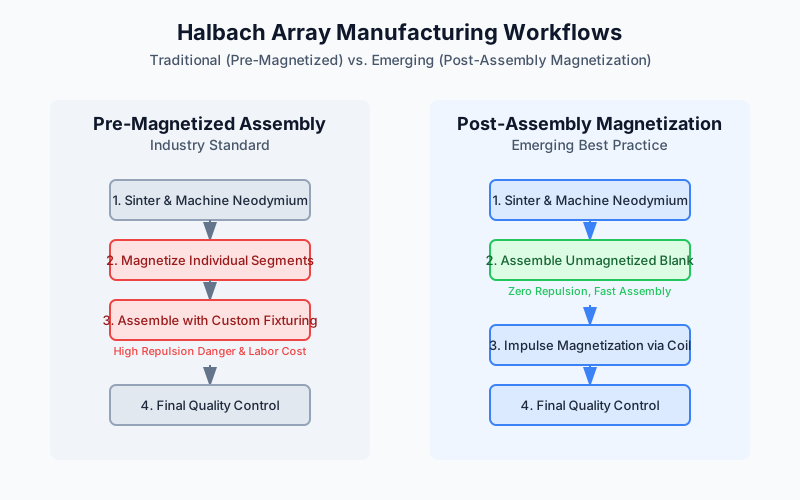
Halbach Array Manufacturing: Cost vs. Yield in Assembly-First vs. Magnetize-Later Techniques
Compare Halbach array assembly-first vs magnetize-later manufacturing by cost, yield, grade limits, supplier checks, and RFQ timing.
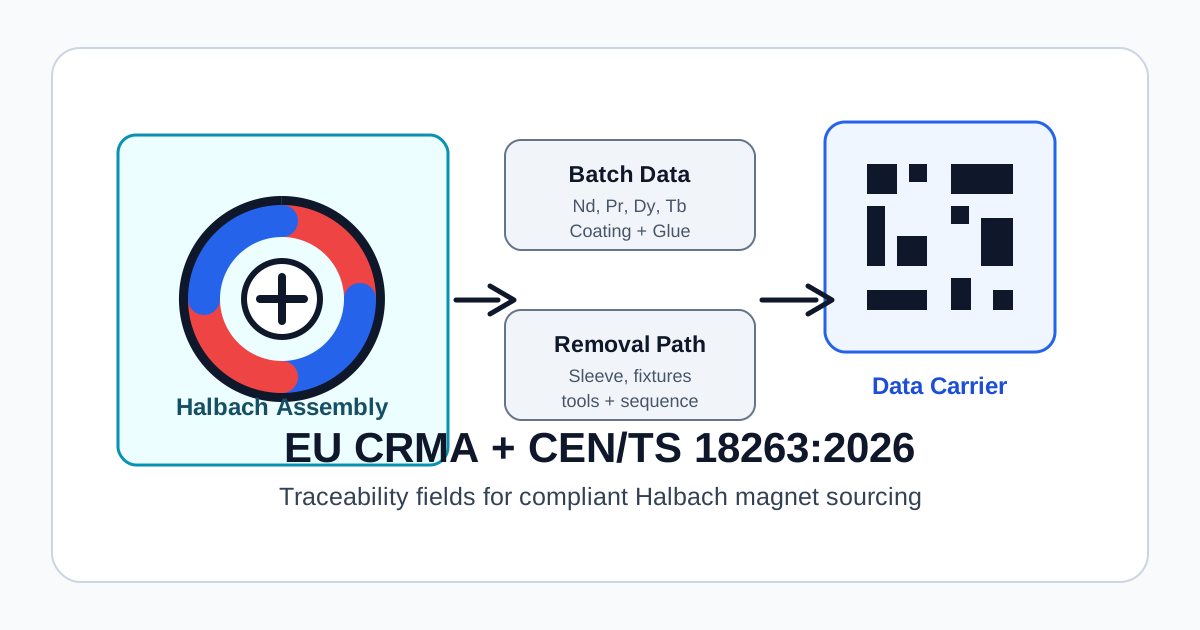
Halbach Array Supply Chain Traceability: Preparing for EU CRMA & CEN/TS 18263:2026
Prepare Halbach magnet sourcing for EU CRMA and CEN/TS 18263:2026 with supplier data fields, recycling risks, RFQ checklist, and contact review steps.
Low-HRE NdFeB vs. SmCo in Halbach Magnet Assemblies: 2026 Sourcing Guide
Compare Low-HRE NdFeB vs SmCo for global Halbach magnet assemblies in 2026. Review temperature limits, supply risks, and RFQ checks before custom sourcing.