
Halbach Array Supply Chain Traceability: Preparing for EU CRMA & CEN/TS 18263:2026
Prepare Halbach magnet sourcing for EU CRMA and CEN/TS 18263:2026 with supplier data fields, recycling risks, RFQ checklist, and contact review steps.
Halbach Array Supply Chain Traceability: Preparing for EU CRMA & CEN/TS 18263:2026
For decades, the procurement of Halbach magnet assemblies has been dominated by a singular focus: maximizing magnetic performance while minimizing physical weight and cost. Engineers specified the tightest possible angular tolerances, the highest coercivity Neodymium (NdFeB) or Samarium Cobalt (SmCo) grades, and the strongest industrial adhesives to contain the immense repulsive forces inherent in these complex arrays.
However, as we move through 2026, the paradigm of permanent magnet procurement is undergoing a massive regulatory shift. The European Union's Critical Raw Materials Act (CRMA) and the newly published technical specification CEN/TS 18263:2026 have changed how high-performance magnetic assemblies must be documented, tracked, and eventually recycled. For buyers, distributors, and engineering managers operating globally-but especially those selling into the European market-a Halbach array is no longer just a high-tech component; it is a heavily regulated critical asset.
If your current magnet supplier cannot provide granular, product-level data regarding the chemical composition, coating materials, and end-of-life recycling pathways for your Halbach assemblies, you risk market-surveillance questions, customs data-carrier checks, delayed EU placement on the market, or recycled-content disclosure failures from 2027 onward.
This report provides a comprehensive breakdown of the new regulatory landscape, explains why the unique construction of Halbach arrays makes them particularly sensitive to these recycling mandates, and offers a concrete procurement checklist to ensure your supply chain remains compliant and resilient.
The 2026 Regulatory Landscape for Permanent Magnets
The push for traceability is not a sudden development, but 2026 is the transition year where voluntary sustainability work becomes tied to binding legal requirements. The core of this shift is the EU Critical Raw Materials Act (Regulation (EU) 2024/1252): it is already in force, its recycled-content calculation and verification rules are due by 24 May 2026, and public recycled-content disclosure for qualifying products starts by 24 May 2027 or two years after that delegated act, whichever is later.
The EU CRMA and Articles 28 & 29
The CRMA was designed to secure the EU’s supply of critical materials, particularly the Rare Earth Elements (REEs) like Neodymium (Nd), Praseodymium (Pr), Dysprosium (Dy), and Terbium (Tb) that are essential for high-performance permanent magnets. Because Europe currently imports the vast majority of these materials, the CRMA mandates a shift toward a circular economy.
Specifically, the Act sets an ambitious benchmark: by 2030, Union recycling capacity should be able to produce at least 25% of the Union's annual consumption of strategic raw materials. To make permanent magnet recycling practical, Articles 28 and 29 create product-level obligations for selected product groups placed on the EU market, including electric vehicles, wind turbines, MRI machines, industrial robots, electric motors, heat pumps, and several appliances when they contain covered permanent magnet types.
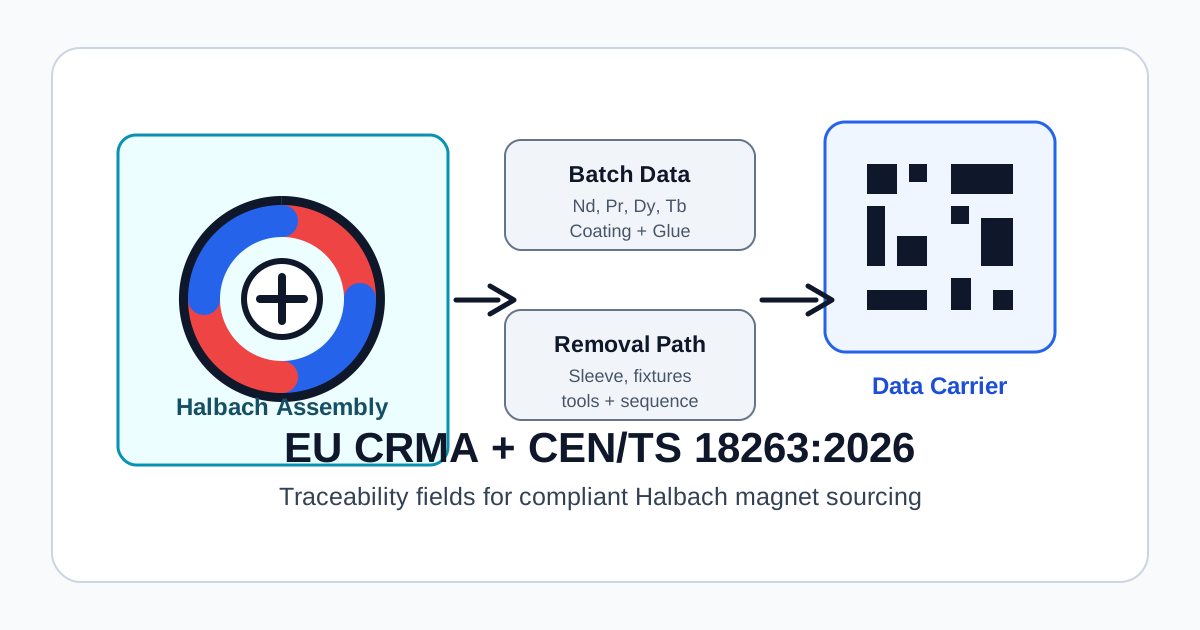
Manufacturers and importers must ensure their magnetic components are traceable. This includes providing a data carrier-a bar code, 2D symbol, or other automatic identification medium-that links to a unique product identifier and makes magnet composition, location, coating, glue, additive, and safe-removal information accessible to downstream users and recyclers.
The Role of CEN/TS 18263:2026
While the CRMA provides the legal mandate, CEN/TS 18263:2026 (Permanent magnet products – Procedure for declaring recycling-relevant information) provides the technical execution standard. Published by the European Committee for Standardization, this specification standardizes exactly what information must be declared to recyclers.
In practical procurement terms, the CRMA data set and the CEN/TS 18263:2026 declaration procedure make it insufficient to state only "Contains NdFeB." Procurement must secure documentation detailing alloy composition, the presence of heavy rare earths (HREs), the type of protective coatings used (e.g., Ni-Cu-Ni, Zinc, or Epoxy), adjacent fixation materials, and the bonding agents utilized in the assembly.
Why Halbach Arrays Are Uniquely Vulnerable to Recycling Mandates
Understanding the regulatory text is only half the battle. Procurement teams must understand why Halbach assemblies, more so than standard dipole magnets, present a massive headache for end-of-life recycling—and therefore require much more rigorous documentation during the sourcing phase.
A standard electric motor might use discrete, unbonded magnets slotted into a rotor. These can often be mechanically pushed out and recycled with relative ease. A Halbach array is entirely different.
1. Extreme Bonding and Adhesive Contamination
Because adjacent magnets in a Halbach array are oriented in opposing or perpendicular directions, they naturally want to repel one another with violent force. To maintain structural integrity, manufacturers use high-strength, heat-cured industrial epoxies to bond the magnets together. From a recycling perspective, this epoxy is a severe contaminant. When the end-of-life assembly is subjected to hydrogen decrepitation (HD) or hydrometallurgical recycling, the thick layers of cured epoxy can disrupt the chemical extraction of rare earths. CRMA Article 28 explicitly calls for information on coatings, glues, additives, and safe magnet removal; for Halbach arrays, procurement should translate that obligation into adhesive family, cure condition, and approximate adhesive mass per assembly so recyclers can choose the correct pre-treatment process.
2. Mechanical Retention Sleeves
High-speed Halbach rotors (such as those used in precision machine tools or aerospace actuators) often require external retention sleeves to prevent the magnets from flying outward due to centrifugal forces. These sleeves are typically made from carbon fiber reinforced polymer (CFRP), Titanium, or Inconel. The presence of these tightly fitted (often interference-fit) sleeves makes accessing the bare magnets incredibly difficult. Your supplier must document the exact material of the sleeve and provide disassembly instructions or CAD models as part of the compliance data package.
3. Coating Complexity in Wedges and Segments
Halbach cylinders are frequently built using custom arc-segments or trapezoidal wedges. To ensure total corrosion resistance, these individual segments are heavily coated, sometimes with multiple layers (e.g., a base layer of Nickel, a layer of Copper, and an outer layer of Epoxy). The exact mass and chemical makeup of these coatings must be traceable to calculate the true yield of recoverable NdPr.
Data Flow for Halbach Array Compliance
Halbach Application Boundaries & Failure Risks in Compliance
When moving from a standard magnetic component to a Halbach array under the new CRMA constraints, procurement and engineering teams must carefully map out Application Boundaries and Failure Risks to ensure the array does not fail under operational stresses while remaining compliant.
- Specification Dimensions & Boundaries: Halbach arrays excel in environments requiring intense, localized magnetic fields (e.g., planar arrays for semiconductor lithography, or cylindrical rotors for high-speed BLDC motors). However, their operational boundary is heavily dictated by thermal limits. Because of the opposing forces, if the array exceeds the maximum operating temperature (often >150°C for standard NdFeB), the opposing magnets will irreversibly demagnetize each other at an accelerated rate compared to standard dipole setups.
- Failure Risks in End-of-Life: A major failure risk under CEN/TS 18263 is selecting an adhesive with a higher decomposition temperature than the magnets' Curie temperature. If recyclers must heat the assembly to break the epoxy, they risk destroying the magnetic properties or causing hazardous off-gassing.
- Buyer Decision Points: When defining the specification, buyers must balance the need for structural rigidity against the "Design for Recycling" (DfR) mandate. Can the array be contained in a mechanical sleeve instead of being potted in solid epoxy? This decision directly impacts your Digital Product Passport rating.
- Supplier Communication Fields: Your RFQ (Request for Quote) must now include explicit fields for: Epoxy Chemical Family, Cure Temperature, Sleeve Interference Fit Tolerance, and Coating Mass per Segment.
Data Requirements: What Procurement Must Request
To ensure that your imported or integrated Halbach arrays meet the latest European traceability standards, your sourcing contracts and Purchase Orders (POs) must explicitly demand specific documentation. It is no longer acceptable to rely purely on dimensional drawings and a generic BH curve.
The following structural table outlines the exact data points you must extract from your magnet manufacturing partner, categorized by compliance necessity.
| Data Category | Specific Metric Required | Relevance to CRMA & CEN/TS 18263 | Procurement Action Item |
|---|---|---|---|
| Alloy Chemistry | Exact wt% of Nd, Pr, Dy, Tb | Defines the strategic value and recycling yield of the assembly. | Require a certified Mill Test Report (MTR) or ICP-OES analysis for every batch. |
| Coating Specification | Type, thickness (µm), and mass | Recyclers must strip coatings chemically or mechanically; mass affects total magnet weight calculations. | Ensure drawing notes specify the exact coating chemistry, not just "NiCuNi." |
| Adhesive Documentation | Chemical family (e.g., Loctite EA series), cure temp | Epoxies contaminate hydrometallurgical recycling. Knowing the chemical family allows for targeted dissolution. | Request Safety Data Sheets (SDS) and approximate adhesive mass per assembly. |
| Retention Materials | Sleeve material (Titanium, CFRP, etc.) | Non-magnetic retention sleeves must be sheared or milled off before magnet recovery. | Include sleeve material codes in the Digital Product Passport BOM. |
| Traceability ID | Batch/Lot number per assembly | CRMA requires product-level traceability to track origins and avoid sanctioned entities. | Demand permanent laser-etching on the assembly housing linking to digital records. |
| Recycled Content % | Post-consumer vs. Post-industrial scrap % | Article 29 requires public disclosure for qualifying products from 2027 onward; minimum shares are to be set later and in any event by 31 December 2031. | Begin auditing suppliers now for their ability to integrate verifiable recycled REEs. |
Cost and Lead Time Implications for 2026-2027
Adapting to this compliance-heavy environment will inevitably impact your procurement KPIs. Implementing traceability systems requires overhead, and suppliers who maintain strict lot control and chemical transparency command a premium over legacy manufacturers who operate as black boxes.
1. Sourcing Consolidation: Expect to consolidate your supplier base. Many Tier-3 magnet workshops will be unable to generate the auditable data required by CEN/TS 18263:2026. Procurement must pivot toward vertically integrated manufacturers or highly sophisticated assembly partners who possess in-house spectrometry (ICP-OES) and rigorous document control systems.
2. Price Volatility Mitigation: The CRMA is explicitly designed to reduce reliance on single-country imports for raw Neodymium and Praseodymium. As supply chains diversify to include Australian, North American, and European mining and refining nodes, expect short-to-medium-term price volatility. Forward-thinking procurement teams are negotiating indexed contracts linked to specific, verifiable REE pricing indices, rather than fixed-price long-term agreements that suppliers may inevitably break.
3. Extended NPI Cycles: New Product Introduction (NPI) lead times will stretch. Designing a Halbach array now requires "Design for Recycling" (DfR) reviews. Engineering teams must collaborate with procurement to choose adhesives and retention methods that balance mechanical performance with end-of-life dismantlability.
Sourcing Checklist for CRMA-Compliant Halbach Assemblies
Before placing a mass-production PO for a new Halbach rotor or planar array, work through this checklist with your supplier’s quality and engineering teams:
- Material Origin Verification: Has the supplier documented the country of origin for the mining, refining, and alloy-casting stages, not just the final assembly location?
- Chemistry Certification: Do they provide batch-level chemical analysis proving the exact percentage of heavy rare earths (Dysprosium/Terbium)?
- CEN/TS 18263 Readiness: Can the supplier output the specific data fields required by CEN/TS 18263:2026 for inclusion in your Digital Product Passport?
- Adhesive Transparency: Are the exact adhesives and potting compounds used in the Halbach array clearly defined with accompanying chemical safety data?
- Design for Disassembly: Has the supplier provided a theoretical disassembly sequence for the mechanical housing or retention sleeve to facilitate future recycling?
- Quality Management Systems: Is the supplier operating under an actively audited ISO 9001 and ISO 14001 framework to guarantee data fidelity?
Frequently Asked Questions (FAQ)
Q: Do these CRMA regulations apply to small, prototype orders of Halbach arrays? A: While prototype R&D orders might bypass immediate customs scrutiny, any product that enters commercial circulation in the EU—regardless of volume—falls under the purview of product safety and environmental directives. Furthermore, qualifying a non-compliant supplier during prototyping guarantees a painful and expensive re-qualification phase when moving to mass production.
Q: Can we just use standard magnet blocks and assemble the Halbach array ourselves to avoid supplier compliance issues? A: In-house assembly shifts the compliance burden entirely onto your organization. You will still need to extract the raw material data from the block magnet supplier, and you will now be legally responsible for documenting the adhesives, coatings, and assembly processes for the final data carrier. Given the severe safety hazards of manually assembling repelling NdFeB magnets, it is almost always more efficient to partner with a compliant, specialized assembly manufacturer.
Q: Our Halbach array is hermetically sealed inside a laser-welded stainless steel housing. Does it still need a recycling declaration? A: Yes. In fact, hermetically sealed assemblies are specifically targeted because they are "hard-to-dismantle." CEN/TS 18263 requires you to declare the presence of the magnets inside the housing and provide instructions or data to recyclers on how to breach the housing (e.g., cutting planes or weld locations) safely.
Q: How does this affect Samarium Cobalt (SmCo) Halbach arrays? A: SmCo magnets are also classified as containing critical raw materials (Cobalt and Samarium). While the recycling infrastructure for SmCo differs from NdFeB, the traceability and data declaration requirements under the CRMA apply equally to SmCo-based assemblies.
Navigating the Future of Magnetic Assembly Procurement
The days of treating permanent magnets as untraceable commodities are over. For engineering-heavy components like Halbach arrays, where performance dictates complex and difficult-to-recycle construction methods, compliance is now a primary sourcing metric. By updating your supplier quality requirements to align with the EU CRMA and CEN/TS 18263:2026, you protect your supply chain from regulatory bottlenecks and position your products for success in a rapidly evolving, circular global economy.
Secure Your Compliant Halbach Supply Chain
Are you concerned about your current supplier's ability to meet the impending 2026 and 2027 traceability standards? At Halbach Magnet, we engineer high-performance magnetic assemblies with total supply chain transparency in mind.
From verifiable material origins and exact chemistry declarations to optimized "Design for Recycling" assembly techniques, our engineering team ensures your Halbach rotors and planar arrays meet both your performance specs and your compliance obligations.
Contact our engineering team today to review your current assembly designs, request a compliance audit, or discuss your next generation of traceable magnetic systems.
Sources & References
- Regulation (EU) 2024/1252 of the European Parliament and of the Council (Critical Raw Materials Act). Official Journal of the European Union, May 2024. Eur-Lex
- CEN/TS 18263:2026 - Permanent magnet products - Procedure for declaring recycling-relevant information. European Committee for Standardization (CEN), published April 2026. UNI standard listing
- Binnemans, K. et al. Recycling of Rare Earths: a Critical Review. Journal of Cleaner Production, 2013. DOI: 10.1016/j.jclepro.2012.12.037
Author

Categories
More Posts
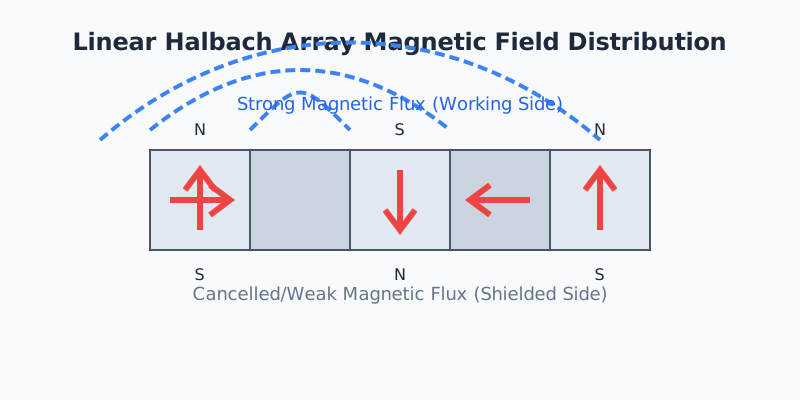
The Engineer’s Guide to Halbach Magnet Assemblies: Costs, Tolerances, and Sourcing Checklist
A comprehensive guide for engineers and procurement teams on sourcing Halbach magnet assemblies, balancing tolerances, manufacturing costs, and structural integrity.
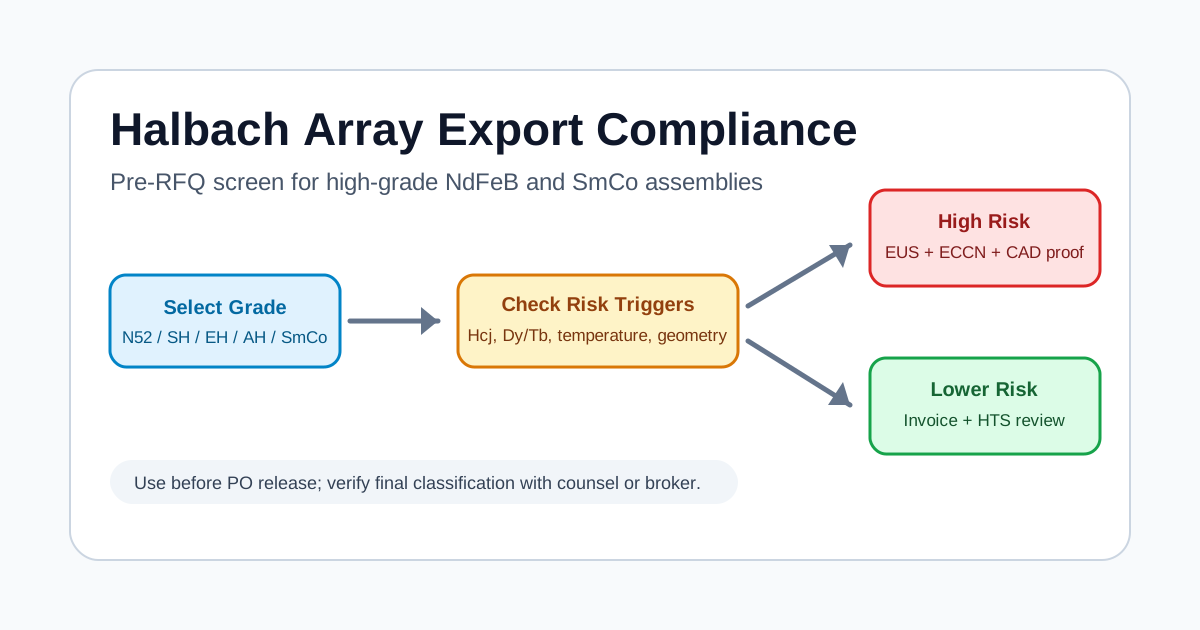
Navigating Export Controls and Dual-Use Compliance for High-Grade Halbach Arrays
Procurement guide to sourcing high-grade NdFeB and SmCo Halbach arrays without dual-use export control delays, customs seizures, or legal penalties.
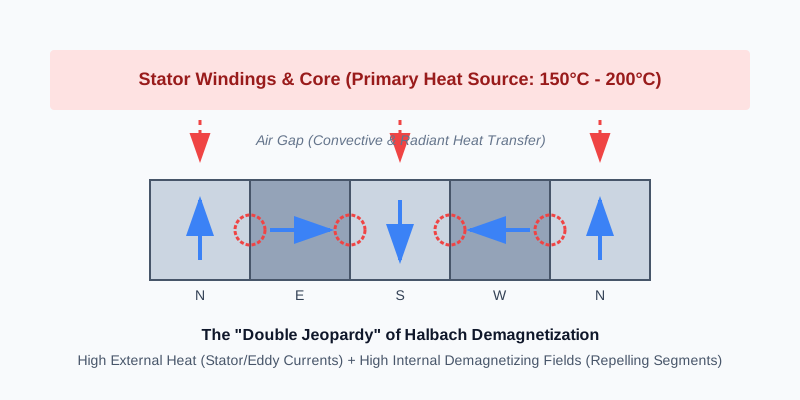
Preventing High-Temperature Demagnetization in Halbach Array Rotors: Material Selection and Engineering Safeguards
Specify high-coercivity NdFeB, thermal safeguards, and RFQ tests to prevent Halbach rotor demagnetization in high-temperature electric motor programs.