
Segmented Halbach Arrays vs. Solid Rings: Managing Eddy Current Losses and Sourcing Costs
Compare segmented Halbach arrays and solid rings for eddy current loss control, sourcing cost trade-offs, and RFQ checks for high-speed magnet rotors.
Segmented Halbach Arrays vs. Solid Rings: Managing Eddy Current Losses and Sourcing Costs
As industries push the boundaries of electrification, the demand for high-speed, high-efficiency permanent magnet synchronous motors (PMSM) and brushless DC (BLDC) motors has skyrocketed. From high-speed drones and high-performance electric vehicles (EVs) to advanced turbomachinery, engineers are constantly seeking ways to increase power density without adding weight. The Halbach array rotor has emerged as the premier solution for these applications.
However, operating a permanent magnet rotor at tens of thousands of RPMs introduces a critical thermal bottleneck: eddy current losses. When high-frequency stator harmonics interact with highly conductive Neodymium (NdFeB) or Samarium Cobalt (SmCo) magnets, they induce electrical currents within the magnets themselves. These currents generate massive amounts of heat, threatening to push the magnets past their maximum operating temperature and causing irreversible demagnetization.
The proven engineering solution is to segment the magnets—slicing them into smaller pieces and insulating them to restrict the flow of eddy currents. But from a procurement perspective, adding sub-segmentation to a Halbach array—an assembly that is already notoriously complex and expensive to manufacture—can cause sourcing costs to spiral out of control.
In this comprehensive guide, we will explore the physics of eddy current losses, compare the performance of solid vs. segmented Halbach assemblies, analyze the cost-benefit ratio of different segmentation strategies, and provide a strict sourcing checklist for buyers evaluating high-performance magnetic suppliers.
The Physics of Eddy Current Losses in High-Speed Rotors
To understand the sourcing challenge, procurement teams must first understand the physics driving the engineering requirements.
Permanent magnets like NdFeB are not perfect insulators; they are sintered metals with relatively high electrical conductivity. When a motor operates, the magnetic field interacting with the rotor is not perfectly smooth. Factors such as stator slot openings, inverter pulse-width modulation (PWM) switching frequencies, and non-sinusoidal winding distributions create "space harmonics" and "time harmonics."
According to Faraday's Law of Induction, these fluctuating magnetic fields induce an electromotive force (EMF) within the conductive permanent magnets. This EMF drives localized, swirling electrical currents known as eddy currents.
Because the magnet has electrical resistance, these circulating currents generate heat (Joule heating). The power loss ($P_e$) due to eddy currents is generally proportional to the square of the frequency ($f$), the square of the peak magnetic flux density ($B$), and the square of the magnet's dimension perpendicular to the flux ($d$):
$P_e \propto f^2 \cdot B^2 \cdot d^2$
In low-speed motors, eddy current losses are negligible. However, as motor speeds exceed 20,000 RPM, the frequency ($f$) becomes massive. The resulting heat cannot easily dissipate through the rotor shaft, leading to rapid temperature spikes that can permanently destroy the magnet's coercivity.
Why Halbach Arrays Are Uniquely Vulnerable to Harmonics
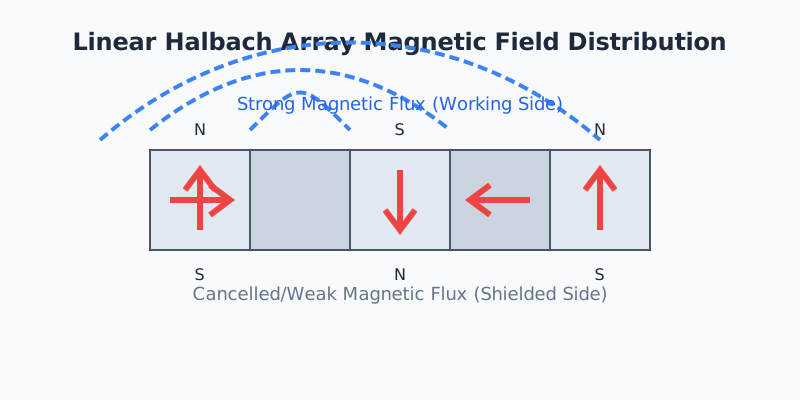
Halbach arrays are designed to concentrate the magnetic flux on the working side (facing the stator) and cancel it on the shielded side (facing the rotor core). This self-shielding effect eliminates the need for a heavy iron yoke, vastly reducing rotor inertia.
However, this unique topology makes Halbach rotors particularly sensitive to eddy current losses for two reasons:
- Closer Proximity to Stator Harmonics: Because Halbach arrays are often surface-mounted (SPM) to maximize the concentrated air-gap flux, the magnets are positioned directly adjacent to the stator teeth. They are hit with the full, unfiltered force of the slot harmonics, unlike interior permanent magnet (IPM) designs where the steel rotor core acts as a buffer.
- Complex Magnetization Angles: The varying magnetization vectors of adjacent Halbach poles mean that the induced eddy current loops form complex, unpredictable 3D paths that can interact across magnet boundaries if not properly insulated.
The Solution: Magnet Segmentation
Looking at the proportional formula above, we cannot easily reduce the motor speed ($f$) or the required magnetic flux ($B$) without sacrificing motor performance. The only variable engineers can control is $d$—the dimension of the magnet.
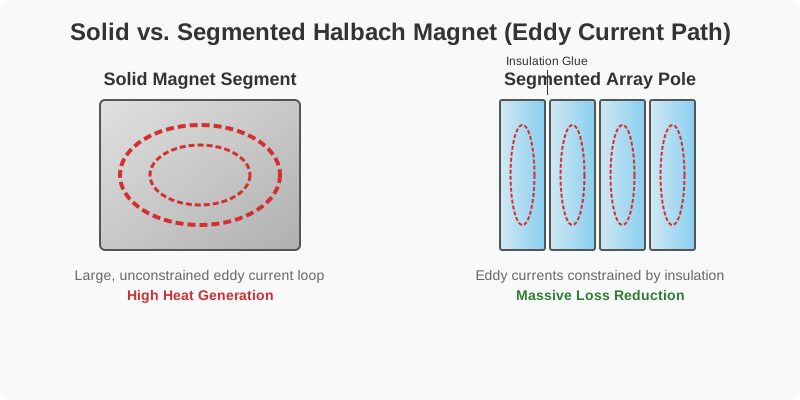
By slicing a solid magnet into smaller segments and bonding them back together with a high-temperature, electrically insulating epoxy, we physically restrict the size of the eddy current loops. Smaller loops mean significantly higher electrical resistance along the path, drastically reducing the total induced current and the resulting heat.
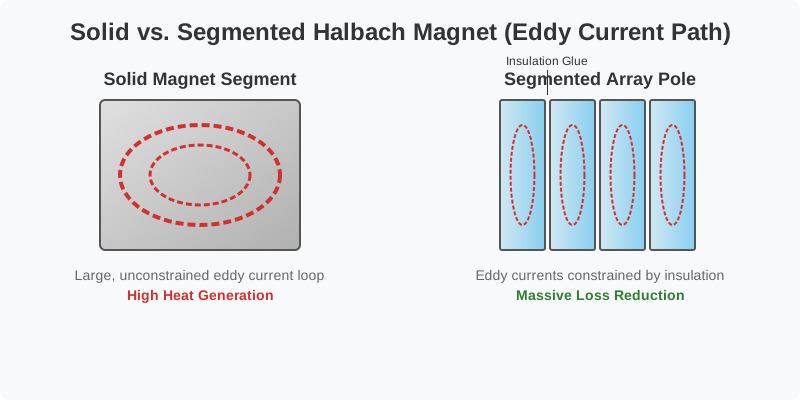 Figure 1: Comparison of large unconstrained eddy currents in a solid magnet versus restricted eddy current loops in a fully segmented array.
Segmentation can be performed in two directions:
- Axial Segmentation: Slicing the magnets along the length of the rotor. This is the most common and cost-effective method to combat axial eddy currents caused by stator slot harmonics.
- Circumferential (Azimuthal) Segmentation: Slicing the magnets along the curve of the rotor. This is much more difficult to manufacture but is required to combat circumferential harmonics.
Cost vs. Loss Reduction: The Law of Diminishing Returns
For procurement teams, the critical realization is that magnet segmentation follows a strict law of diminishing returns.
Slicing a solid magnet into 2 or 3 segments provides a massive reduction in eddy current losses. However, slicing it into 10 segments doubles the manufacturing cost while only providing marginal additional thermal benefits.
The table below illustrates a generalized cost-vs-performance analysis for an axial-segmented Halbach array rotor compared to a solid Halbach array baseline.
| Configuration | Eddy Current Loss Reduction | Assembly Time Multiplier | Scrap / Yield Risk | Estimated Cost Premium | Ideal Application Scenario |
|---|---|---|---|---|---|
| Solid Array (Baseline) | 0% (Maximum Heat) | 1.0x | Low | Baseline Cost | Low-speed motors, low PWM frequency, highly cooled environments. |
| 2 Segments per Pole | ~40% - 50% | 1.8x | Moderate | +30% to 45% | Standard high-speed industrial spindles; first step in thermal management. |
| 3 Segments per Pole | ~65% - 75% | 2.5x | Moderate-High | +60% to 80% | EV traction motors, high-frequency HVAC compressors. |
| 5 Segments per Pole | ~80% - 85% | 4.0x | High | +120% to 150% | High-speed drones, turbomolecular pumps, extreme RPM applications. |
| 10+ Segments per Pole | ~90% - 95% | 8.0x+ | Extreme | +300% or more | Specialized cryogenic or vacuum applications. |
| Partial Segmentation | ~30% - 60% | 1.3x | Low-Moderate | +15% to 25% | Cost-sensitive commercial applications balancing thermal and budget limits. |
Note: Percentages and costs are illustrative industry averages. Actual values depend on specific geometry, NdFeB grade, and stator design.
The Hidden Manufacturing Costs of Segmented Halbach Arrays
When you request a quote for a segmented Halbach array, the sticker shock can be severe. Why does cutting a magnet in half increase the price by 40%? It comes down to the compounding difficulties of manufacturing.
1. The Kerf Loss and Machining Time
Neodymium magnets are extremely hard and brittle. They cannot be stamped or cast into final shape; they must be sliced using diamond wire saws or grinding wheels. Every cut introduces "kerf loss"—the material turned into dust by the cutting tool. If you slice a magnet into 5 segments, you might lose 15% of your expensive raw material just to the saw blade. Furthermore, the slicing process must be done slowly under heavy coolant to prevent the magnet from overheating and losing its magnetic properties during machining.
2. The Nightmare of Halbach Assembly
Assembling a standard Halbach array is already dangerous. Adjacent magnets are oriented to repel each other with hundreds of pounds of force. To assemble them safely, manufacturers use custom-machined aluminum or brass fixturing jigs.
When you segment the array, you multiply the number of pieces the assembly technician must handle. A standard 8-pole Halbach rotor might have 16 magnet blocks. If each block is segmented into 5 pieces, the assembly now consists of 80 individual, highly repulsive, brittle shards of Neodymium that must be perfectly aligned, insulated, and glued.
3. Insulation Glue and Curing Time
The epoxy used between segments is not standard glue. It must possess high shear strength, high thermal stability (often rated for 150°C to 200°C), and excellent dielectric insulation properties. Applying a consistent, thin layer of this epoxy between 80 repelling segments—and holding them in precise alignment while the epoxy cures in an oven—requires controlled assembly processes.
Partial Segmentation: A Procurement Middle-Ground
If the cost of a fully segmented Halbach array breaks your project's budget, engineers and procurement teams should consider Partial Segmentation.
Instead of cutting the magnet entirely into separate pieces, the manufacturer uses a thin diamond saw to cut slots into the surface of the magnet (usually on the side facing the stator), leaving a solid base connected at the bottom. The slots are then filled with insulating epoxy.
Advantages of Partial Segmentation:
- Lower Manufacturing Cost: Because the magnet remains a single structural piece, the manufacturer does not have to assemble and glue dozens of tiny fragments. It can be handled and inserted into the Halbach array as a single block.
- Maintained Structural Integrity: The solid base prevents the magnet from shattering as easily under the extreme repulsive forces of the Halbach configuration.
- Significant Loss Reduction: Because eddy currents are highest near the surface facing the stator, cutting slots deep enough into the surface disrupts the primary current paths, often achieving 70% of the benefit of full segmentation at a fraction of the cost.
Structural Retention in High-Speed Segmented Rotors
A critical failure mode that procurement teams often overlook is mechanical retention. Neodymium is notoriously weak in tension. When a segmented Halbach rotor spins at 50,000 RPM, the centrifugal forces are immense.
Because a segmented array is held together primarily by epoxy, the structural integrity of the rotor is fundamentally compromised compared to a solid ring. If the epoxy softens at high temperatures, the segments will detach, instantly destroying the motor stator.
To mitigate this, buyers must ensure their supplier provides reliable retention solutions:
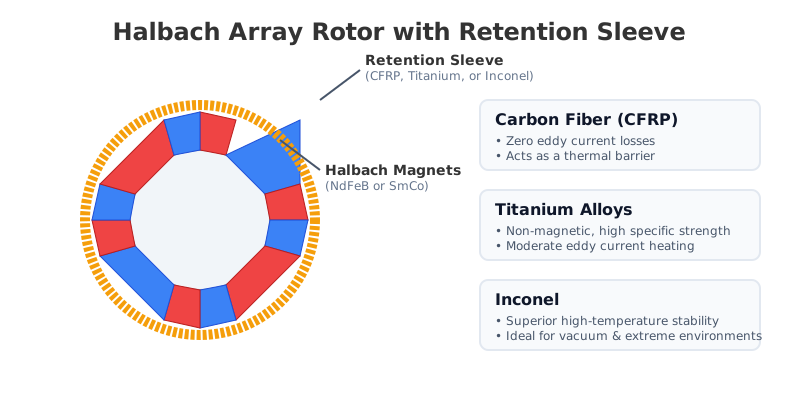
- Carbon Fiber or Kevlar Banding: The most common solution for high-speed rotors. The manufacturer wraps the finished Halbach array in high-tensile carbon fiber tow pre-impregnated with epoxy, then cures it. This provides immense radial compression.
- Titanium or Inconel Sleeving: For extreme environments or vacuum applications where epoxy outgassing is unacceptable, a thin-walled, non-magnetic metallic sleeve is press-fit or shrink-fit over the magnets. Note that metallic sleeves will introduce their own (albeit small) eddy current losses.
Sourcing Checklist: Vetting Suppliers for Segmented Arrays
Procuring segmented Halbach assemblies is not a standard catalog purchase. Sourcing these components from a generic magnet factory will almost certainly result in catastrophic failure during motor testing. Use this checklist when vetting potential manufacturing partners:
Technical Validation
- Do they offer Electromagnetic FEA Simulation? The supplier should be able to simulate your stator design and prove exactly how many segments are required to bring eddy current losses below your thermal limits.
- Can they verify the insulation resistance? The supplier should test the dielectric strength of the epoxy bonds between segments. If the epoxy layer is too thin or contains conductive Neodymium dust, the segments will short-circuit, rendering the segmentation useless.
Manufacturing Capabilities
- Do they have custom fixturing experience? Ask to see examples of their non-magnetic assembly jigs. They must demonstrate the ability to safely assemble highly repulsive arrays without relying solely on manual labor.
- What is their minimum kerf loss? Evaluate their machining capabilities. Suppliers with advanced ultra-thin diamond wire saws will waste less raw material, resulting in lower piece-prices for heavily segmented designs.
- Do they offer in-house retention wrapping? Avoid suppliers that have to outsource carbon fiber wrapping or titanium sleeving. In-house retention ensures the final outer diameter (OD) tolerances are strictly controlled.
Quality Control
- High-Speed Dynamic Balancing: Because segmented arrays use varying amounts of epoxy, mass distribution is never perfect. The supplier must offer dynamic rotor balancing (often by adding balance weights to the end caps or selectively grinding the retention sleeve) after final assembly.
- Magnetic Angle Verification Plan: In a Halbach array, the angle of magnetization for each segment is critical. Confirm the supplier's Helmholtz coil method, sampling plan, and reporting requirements before assembly.
Frequently Asked Questions (FAQ)
Q: Can we use Samarium Cobalt (SmCo) instead of Neodymium (NdFeB) to avoid the need for segmentation? A: SmCo has a much higher temperature tolerance (up to 350°C) compared to NdFeB (typically up to 150°C-200°C), meaning it can withstand more eddy current heating before demagnetizing. However, SmCo has a higher electrical resistivity than NdFeB, which actually helps reduce eddy currents naturally. That said, in extreme high-speed applications, even SmCo will overheat and require segmentation. Furthermore, SmCo is significantly more brittle than NdFeB, making the machining and segmentation process even more difficult and prone to chipping.
Q: Is it better to segment the magnets axially or circumferentially? A: Axial segmentation (slicing along the length of the rotor) is standard practice and highly effective against the dominant eddy currents caused by stator slot harmonics. Circumferential segmentation is much more expensive and is usually only pursued when inverter switching harmonics (time harmonics) are the primary source of the heat.
Q: Does the insulating epoxy layer reduce the overall magnetic field strength? A: Yes. Every micron of space taken up by non-magnetic epoxy is space that is not occupied by magnetic material. This reduces the total magnetic volume of the rotor, slightly lowering the overall magnetic flux density (the "fill factor" decreases). Engineers must balance the slight loss in raw magnetic power against the massive gains in thermal stability.
Q: Why not use bonded Neodymium magnets instead of sintered, segmented magnets? A: Bonded Neodymium magnets (made from magnetic powder mixed with a polymer binder) have extremely high electrical resistance, effectively eliminating eddy current losses without the need for physical segmentation. However, their magnetic strength (BHmax) is only a fraction of sintered Neodymium. For high-performance motors where power density is paramount, bonded magnets simply cannot provide the required flux.
Conclusion
Managing eddy current losses in high-speed permanent magnet motors is a delicate balancing act between engineering necessity and procurement reality. While the Halbach array offers unparalleled magnetic concentration and lightweight efficiency, its susceptibility to stator harmonics necessitates rigorous thermal management.
Segmenting the magnets is the definitive solution, but as we have seen, it introduces steep manufacturing premiums, increased assembly risks, and mechanical retention challenges. By understanding the law of diminishing returns, considering partial segmentation strategies, and utilizing our strict sourcing checklist, procurement teams can successfully navigate negotiations with advanced magnetic suppliers.
Ensure Your Next High-Speed Rotor Succeeds
Are you struggling to balance thermal limits with sourcing budgets on a new motor design? At Halbach Magnet, our application engineering team specializes in the complex manufacturing of segmented Halbach arrays for EV traction, precision motion, and high-speed industrial applications.
We support FEA simulation to optimize your segment count, precision slicing review to reduce material waste, and carbon-fiber retention sleeve planning for extreme RPM requirements.
Contact our engineering team today to discuss your specific thermal challenges, request a manufacturability review, or get a quote on your custom segmented Halbach assembly.
Sources & References
- MDPI Energies. "The Effects of Permanent Magnet Segmentations on the Flux Density and the Cogging Torque of Permanent Magnet Synchronous Motors." Read more.
- IEEE Transactions on Industry Applications / White Rose Research Online. "Magnet Eddy Current Loss Reduction in Permanent Magnet Machines." Read more.
- MDPI Energies. "Partially Segmented Permanent-Magnet Losses in Interior Permanent Magnet Machines." Read more.
- Mathematical and Computational Applications. "Permanent-Magnet Eddy-Current Losses: A Global Revision of Calculation and Analysis Methods." Read more.
- IEEE Xplore. "Studying rotor eddy current loss of PM machines using nonlinear stator-rotor coupling analysis." Read more.
Author

Categories
More Posts
The Engineer’s Guide to Halbach Magnet Assemblies: Costs, Tolerances, and Sourcing Checklist
A comprehensive guide for engineers and procurement teams on sourcing Halbach magnet assemblies, balancing tolerances, manufacturing costs, and structural integrity.
Low-HRE NdFeB vs. SmCo in Halbach Magnet Assemblies: 2026 Sourcing Guide
Compare Low-HRE NdFeB vs SmCo for global Halbach magnet assemblies in 2026. Review temperature limits, supply risks, and RFQ checks before custom sourcing.
Halbach Array Rotor Retention Sleeves: Carbon Fiber vs. Titanium vs. Inconel
Compare Halbach rotor retention sleeves for high-speed motors: CFRP, titanium, and Inconel trade-offs for eddy losses, thermal limits, and RFQs.