
Low-HRE NdFeB vs. SmCo in Halbach Magnet Assemblies: 2026 Sourcing Guide
Compare Low-HRE NdFeB vs SmCo for global Halbach magnet assemblies in 2026. Review temperature limits, supply risks, and RFQ checks before custom sourcing.
Low-HRE NdFeB vs. SmCo in Halbach Magnet Assemblies: 2026 Sourcing Guide
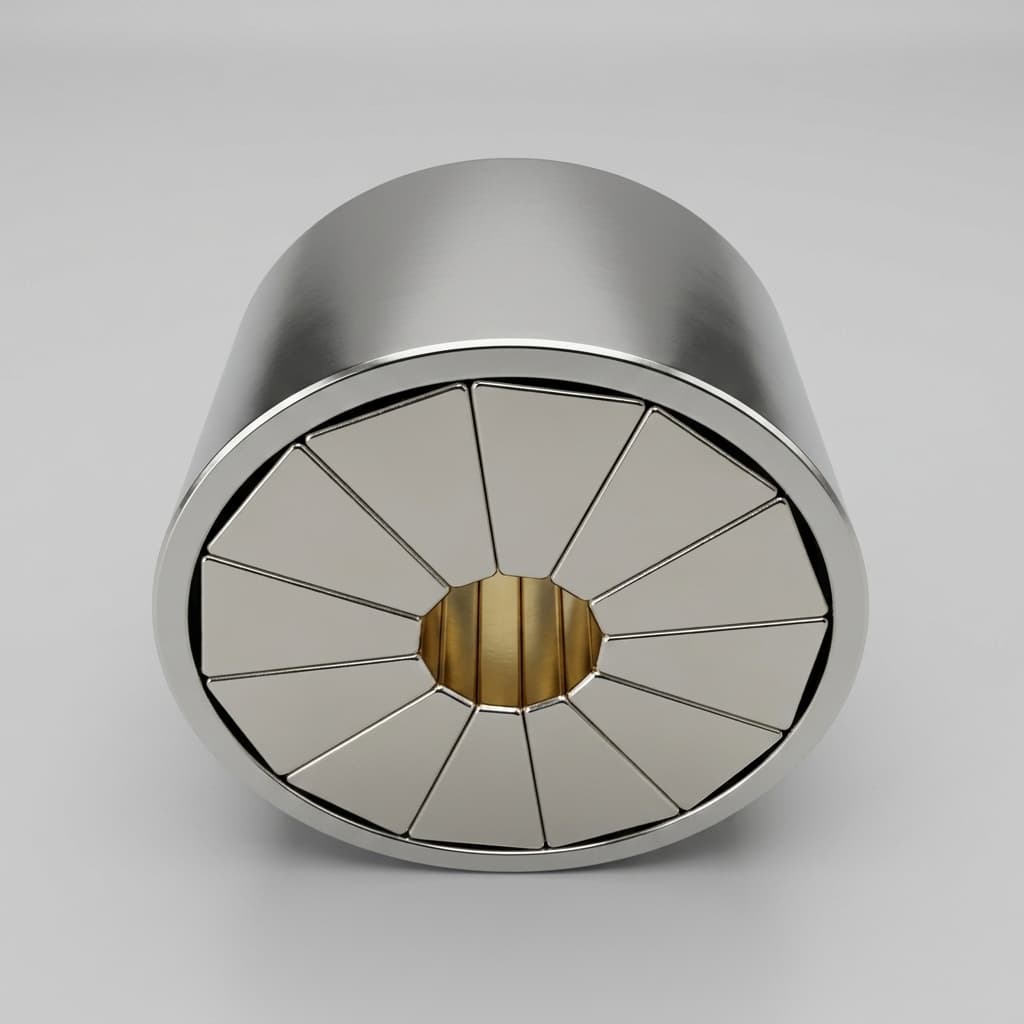
When engineering teams need to maximize magnetic flux density on one side of a system while minimizing it on the other, the Halbach array is the undisputed gold standard. By continuously rotating the magnetization vector of adjacent permanent magnets, Halbach assemblies create a highly concentrated magnetic field without the weight and bulk of heavy iron return paths. They are the driving force behind the next generation of high-speed electric vehicle (EV) traction motors, advanced magnetic bearings, precision particle accelerators, and high-efficiency wind turbine generators.
However, designing a Halbach array is only half the battle. For procurement teams and mechanical engineers in 2026, the material selection process has become incredibly complex. The core debate traditionally centered on Neodymium (NdFeB) for pure strength versus Samarium Cobalt (SmCo) for extreme temperature stability. Today, that decision is complicated by intense supply chain volatility, the push for ESG compliance, and the rapid maturation of Grain Boundary Diffusion (GBD) technologies that have given rise to "Low-HRE" (Heavy Rare Earth) and "HRE-Free" NdFeB grades.
In this comprehensive guide, we will unpack the specific material science demands of the Halbach array, compare the latest Low-HRE NdFeB grades against traditional SmCo, and provide an actionable procurement checklist to help you secure the right magnetic material for your next high-performance assembly.
Scope for this 2026 sourcing guide: This article is written for global procurement and engineering teams buying custom Halbach magnet assemblies for industrial automation, EV traction, medical instrumentation, aerospace, downhole, and research equipment. It is not a spot-price index, a substitute for supplier-specific grade data sheets, or a replacement for thermal and magnetic FEA validation. Use it to shortlist material families before RFQ, then confirm peak temperature, air gap, coating stack-up, segment geometry, and acceptance criteria with your supplier.
If the geometry is not locked yet, compare the procurement constraints for linear Halbach arrays and precision Halbach cylinders before choosing a magnet grade. For active RFQs, send peak temperature, field target, segment count, and inspection requirements through Contact for an engineering review.
1. The Unique Demands of a Halbach Array Environment
Before comparing materials, buyers must understand why Halbach arrays are so punishing on permanent magnets.
In a standard dipole assembly, magnets are oriented in a relatively relaxed state, with flux flowing naturally from North to South. In a Halbach configuration, however, adjacent magnets are forcefully constrained in positions where they naturally want to repel one another. This spatial arrangement means that each magnet within the array is constantly subjecting its neighbor to a massive internal demagnetizing field (H_d).
The Need for High Intrinsic Coercivity (Hcj)
Because the magnets are constantly fighting each other, they must possess extremely high intrinsic coercivity (Hcj)—the material's ability to resist demagnetization. If a standard, low-coercivity magnet is used in a high-density Halbach array, the repulsive forces from adjacent segments can permanently demagnetize it, causing "dead spots" in the field and destroying the array's concentrated flux effect.
The Temperature Multiplier Effect
This risk is exponentially magnified by heat. As the temperature of a permanent magnet rises, its coercivity drops. If an electric motor's Halbach rotor heats up to 150°C during peak load, the combination of high temperature and the array's internal repulsive fields can lead to catastrophic, irreversible demagnetization. Therefore, specifying a material for a Halbach array is never just about the magnetic strength (Br); it is about maintaining that strength under severe thermal and self-inflicted magnetic stress.
2. The Rise of Low-HRE and HRE-Free NdFeB
Historically, to increase the coercivity of NdFeB magnets so they could survive high temperatures (and the stresses of a Halbach array), manufacturers added Heavy Rare Earth Elements (HREEs) like Dysprosium (Dy) or Terbium (Tb). Grades like UH (up to 180°C) and EH (up to 200°C) contained significant percentages of these elements.
However, Dysprosium and Terbium are scarce, highly expensive, and subject to severe geopolitical supply chain bottlenecks.
Grain Boundary Diffusion (GBD) Technology
To solve this, the industry perfected Grain Boundary Diffusion (GBD). Instead of mixing expensive HREEs throughout the entire magnet during smelting, GBD technology coats the surface of a finished sintered NdFeB magnet with Dy or Tb. The magnet is then subjected to a highly controlled heat treatment. The heavy rare earth elements diffuse along the microscopic boundaries between the NdFeB grains, penetrating the magnet's interior.
Figure 1: GBD creates a "core-shell" microstructure. The HREEs concentrate in a hard magnetic shell around each grain, drastically increasing coercivity without wasting expensive Dy/Tb inside the grain core where it reduces overall magnetic flux.
This innovation allows manufacturers to produce Low-HRE and even HRE-Free NdFeB magnets that offer the high coercivity needed for Halbach arrays (withstanding up to 150°C-180°C) but at a significantly lower and more stable cost.
3. When Samarium Cobalt (SmCo) Remains Unmatched
If GBD NdFeB is so efficient, why does SmCo still command a premium in the market? The answer lies in the fundamental physics of the material. SmCo (specifically the widely used Sm₂Co₁₇ type) operates on a completely different magnetic principle than NdFeB.
While NdFeB relies on nucleation mechanisms (which is why the grain boundaries are so important), SmCo relies on domain wall pinning within a cellular nanostructure. This internal structure is incredibly stable when subjected to thermal energy.
Extreme Thermal Stability
SmCo possesses a Curie temperature of over 800°C, compared to roughly 310°C for NdFeB. More importantly, its reversible temperature coefficient of remanence (how much strength it temporarily loses as it gets hot) is typically around -0.03% to -0.04% per degree Celsius. NdFeB, even with GBD, loses roughly -0.11% to -0.12% per degree.
If your Halbach array operates continuously at 200°C, 250°C, or even 350°C, NdFeB is completely disqualified. SmCo is the only material that can reliably hold the specific magnetization vectors required for a functioning Halbach array in these extreme environments.
The Zero-Coating Advantage
NdFeB is essentially composed of iron and will rust rapidly if exposed to moisture, requiring protective coatings (Ni-Cu-Ni, Epoxy, or Parylene). In a tight-tolerance Halbach array, coatings add thickness (increasing the magnetic air gap) and risk flaking during the aggressive assembly process. SmCo contains very little iron and is highly resistant to corrosion. It can be used completely uncoated in aerospace, downhole oil drilling, and vacuum applications.
4. Direct Comparison: Low-HRE NdFeB vs. SmCo
When drafting procurement specifications, buyers must weigh these factors systematically. The table below compares the latest generation of GBD Low-HRE NdFeB against industrial-grade Sm₂Co₁₇ specifically within the context of a Halbach magnet assembly.
| Parameter | Low-HRE NdFeB (GBD Treated) | Samarium Cobalt (Sm₂Co₁₇) | Halbach Array Implications |
|---|---|---|---|
| Max Energy Product (BHmax) | 42 - 52 MGOe | 24 - 32 MGOe | NdFeB yields a stronger field at room temp, enabling more compact Halbach designs. |
| Max Operating Temp (Tmax) | 150°C - 180°C (Grade specific) | 300°C - 350°C (Grade specific) | SmCo is mandatory for high-speed rotors or aerospace actuators exceeding 180°C. |
| Reversible Temp Coefficient (α) | ~ -0.11% / °C | ~ -0.03% / °C | SmCo maintains consistent Halbach flux concentration as the system heats up. |
| Corrosion Resistance | Poor (Coating strictly required) | Excellent (No coating needed) | Uncoated SmCo allows for zero-gap bonding, improving magnetic efficiency. |
| Mechanical Brittleness | Very brittle (chips easily) | Extremely brittle (chips & fractures) | Both require highly specialized fixturing to prevent collisions during Halbach assembly. |
| Machinability (Post-Processing) | Impossible after GBD treatment | Very difficult but possible | NdFeB GBD segments must be machined to final dimensions before the diffusion process. |
| Supply Chain & Pricing Risk | Moderate (Reduced Dy/Tb reliance) | High (Tied to Cobalt market volatility) | Low-HRE NdFeB offers vastly superior budget predictability for mass-market 2026 production. |
| Failure Risk Mode | Oxidation if coating fails, Thermal demagnetization | Catastrophic mechanical shattering | NdFeB requires extreme moisture protection; SmCo requires strict mechanical retention. |
| Cost per kg | $$ | $$$$ | NdFeB provides better value for ambient-to-moderate temperature applications. |
5. The 2026 Procurement & Engineering Checklist
Choosing the wrong material for a complex assembly will either result in catastrophic demagnetization in the field (under-specifying) or severe budget overruns (over-specifying). Use this checklist when collaborating with your magnet manufacturer:
- Define the Absolute Maximum Operating Temperature: Do not guess. Use FEA thermal modeling to determine the peak localized temperature the magnet will experience, not just the ambient temperature of the room. Include a buffer for unexpected thermal excursions.
- Calculate the Internal Demagnetizing Field: Ensure your magnetic simulation software accounts for the severe repulsive forces specific to the exact angles of your Halbach segments. Ask your supplier for the intrinsic coercivity (Hcj) derating curve at your Tmax.
- Evaluate GBD Alternatives for 120°C - 160°C: If your application falls in this range, challenge your engineering team. Do not default to SmCo or traditional Dy-heavy NdFeB. Specify GBD Low-HRE NdFeB to instantly reduce BOM costs.
- Specify Coating Allowances: If using NdFeB, remember that the coating (e.g., 15-20 microns of Nickel-Copper-Nickel) takes up space. In a cylindrical Halbach rotor with 32 segments, those coating layers stack up and alter the internal diameter. Confirm tolerance stack-ups with the supplier.
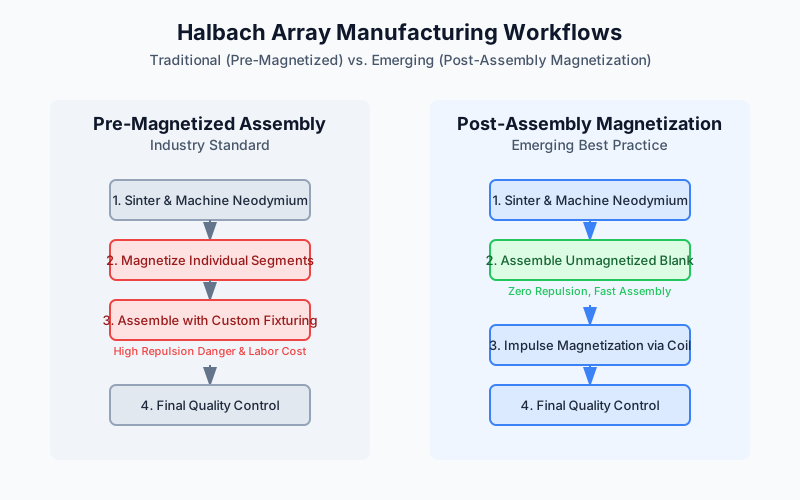
- Confirm Assembly Competence: Both NdFeB and SmCo will shatter violently if magnets slip during the Halbach gluing process. Verify that your supplier uses custom, non-magnetic aluminum or brass fixturing and has experience with high-repulsion assemblies.
- Request 3D Flux Mapping Validation: Because thermal degradation affects Halbach arrays non-linearly, demand a 3D magnetic field map of the first article assembly, both at room temperature and elevated temperatures.
- Establish Clear Acceptance Criteria (AQL): Define magnetic flux deviation limits (e.g., +/- 2% at the working air gap) and visual inspection standards for edge chipping (e.g., no chips larger than 0.5mm on non-mating edges, zero chips on mating edges).
- Confirm Supplier Capabilities: Ask for their specific GBD depth capabilities (often 0.1-0.3mm) and whether they grind before or after coating (grinding after GBD ruins the coercivity shell).
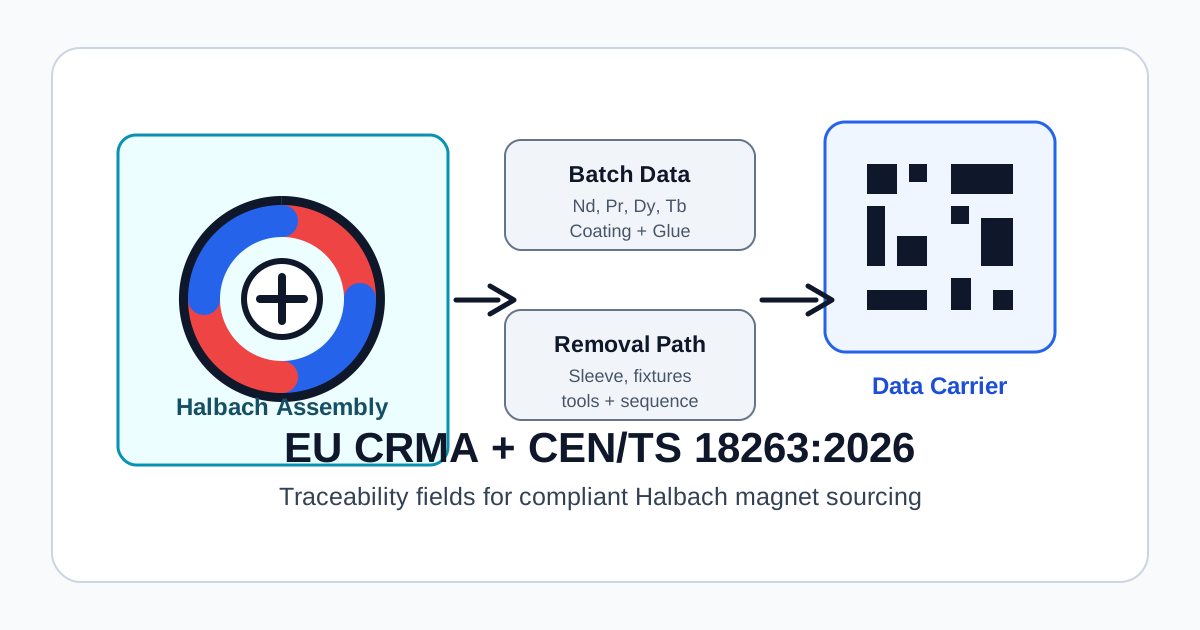
For build-to-print programs, pair this checklist with a custom Halbach engineering review, precision quality control plan, and certifications and supply chain documentation before PO release.
6. Cost vs. Performance: The Total Cost of Ownership
From a pure procurement standpoint, it is tempting to look only at the cost per kilogram. In 2026, a standard GBD Low-HRE NdFeB magnet might cost a fraction of a high-grade SmCo magnet. However, you must evaluate the Total Cost of Ownership (TCO) of the complete assembly.
If you specify NdFeB for a marginal environment (e.g., a motor that occasionally spikes to 190°C), you may save on raw materials but incur massive costs in mechanical retention, active liquid cooling systems, and warranty replacements when the rotor demagnetizes. Conversely, specifying SmCo for a medical device that never exceeds 60°C is an egregious waste of capital, adding unnecessary weight and bulk due to SmCo's lower overall energy density.
The "sweet spot" for modern procurement is aggressively adopting GBD Low-HRE NdFeB for ambient industrial robotics, consumer drones, and standard EVs, while reserving your SmCo budget strictly for aerospace, downhole drilling, and ultra-high-speed kinetic storage flywheels.
7. Frequently Asked Questions (FAQ)
Q: Can a Grain Boundary Diffused (GBD) NdFeB magnet be machined after diffusion? A: No. Because the heavy rare earth elements are concentrated heavily on the outer "shell" of the magnet (typically penetrating only a few tenths of a millimeter), grinding or machining the magnet after the GBD process will strip away the high-coercivity layer. Halbach segments must be precision-ground to their final arc or wedge shape before the GBD treatment is applied.
Q: Are there completely HRE-Free NdFeB grades suitable for Halbach arrays? A: Yes, advancements in grain refinement and microstructure optimization have yielded completely HRE-free NdFeB grades with coercivities high enough to survive Halbach repulsion at ambient or slightly elevated temperatures (up to ~100°C). For anything hotter, GBD low-HRE grades are still required.
Q: Why is SmCo considered harder to assemble if both materials are brittle? A: While both are brittle, SmCo is notoriously fragile and prone to micro-chipping at the sharp edges required for wedge-shaped Halbach segments. Because Halbach assembly requires forceful insertion against strong repulsive fields, the risk of a technician chipping a SmCo segment during fixturing is significantly higher than with NdFeB.
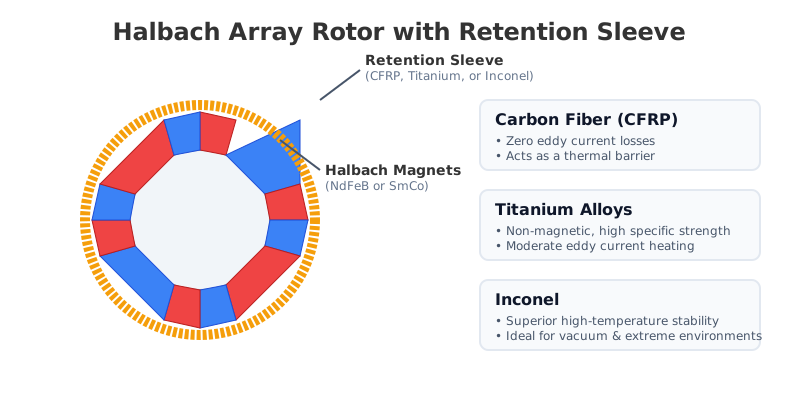
Q: Does SmCo require mechanical retention (like carbon fiber sleeves) in a high-speed rotor? A: Yes. While SmCo solves the magnetic degradation issue at high temperatures, it does not solve the mechanical centrifugal forces. All high-speed Halbach rotors, regardless of material, require a retention sleeve (Carbon Fiber, Titanium, or Inconel) to prevent the segments from flying apart.
Q: How do coating failures impact NdFeB Halbach arrays? A: If the protective coating on an NdFeB segment scratches during assembly, moisture will ingress, causing the iron to oxidize. Rust expands, which can push the adjacent magnets out of alignment, ruining the precision of the Halbach field, and eventually causing the magnet to crumble into powder.
8. Conclusion
The landscape of permanent magnetic materials has evolved rapidly. While Samarium Cobalt remains the undisputed champion for extreme, high-temperature applications, it is no longer the automatic default for anything above 120°C.
By leveraging Grain Boundary Diffusion (GBD) technology, procurement teams can now specify Low-HRE NdFeB for a massive percentage of industrial and automotive Halbach assemblies. This shift not only slashes production costs but insulates supply chains from the geopolitical volatility associated with heavy rare earth elements. Success ultimately lies in rigorous thermal modeling, a deep understanding of your application's true operating limits, and partnering with a manufacturer capable of navigating these tight engineering tolerances.
Optimize Your Halbach Magnet Procurement
Are you struggling to balance performance requirements with material budgets? Specifying the correct magnet grade for a Halbach assembly requires deep expertise in both metallurgy and magnetic field simulation.
At Halbach Magnet, our engineering team works directly with procurement and design professionals to analyze your application, run comprehensive FEA thermal models, and recommend the exact Low-HRE NdFeB or SmCo grade that meets your requirements without over-engineering your budget.
Contact our engineering team today for a manufacturability review, or to request a quote on custom Halbach assemblies built to your exact specifications.
Sources and References
Author

Categories
More Posts
Halbach Array Manufacturing: Cost vs. Yield in Assembly-First vs. Magnetize-Later Techniques
Compare Halbach array assembly-first vs magnetize-later manufacturing by cost, yield, grade limits, supplier checks, and RFQ timing.
Halbach Array Supply Chain Traceability: Preparing for EU CRMA & CEN/TS 18263:2026
Prepare Halbach magnet sourcing for EU CRMA and CEN/TS 18263:2026 with supplier data fields, recycling risks, RFQ checklist, and contact review steps.
Halbach Array Rotor Retention Sleeves: Carbon Fiber vs. Titanium vs. Inconel
Compare Halbach rotor retention sleeves for high-speed motors: CFRP, titanium, and Inconel trade-offs for eddy losses, thermal limits, and RFQs.