
The Engineer’s Guide to Halbach Magnet Assemblies: Costs, Tolerances, and Sourcing Checklist
A comprehensive guide for engineers and procurement teams on sourcing Halbach magnet assemblies, balancing tolerances, manufacturing costs, and structural integrity.
The Engineer’s Guide to Halbach Magnet Assemblies: Costs, Tolerances, and Sourcing Checklist
When engineers need to maximize magnetic field strength while minimizing weight, the Halbach array is often the ultimate solution. By concentrating the magnetic flux on one side of the assembly and canceling it out on the other, a Halbach array delivers unparalleled performance for high-efficiency electric motors, particle accelerators, and advanced magnetic couplings.
However, moving a Halbach array from a theoretical COMSOL simulation to a physical, mass-produced assembly is an entirely different challenge. For procurement teams and engineering managers, sourcing these specialized magnetic assemblies requires navigating high manufacturing costs, dangerous assembly procedures, and strict tolerance requirements.
In this comprehensive guide, we will break down exactly what makes Halbach assemblies so complex to manufacture, how different tolerances impact your bottom line, and the critical checklist every buyer must use when vetting a Halbach magnet supplier.
What Makes the Halbach Array Different?
To understand the sourcing challenges, it is crucial to understand the physics. In a standard magnet assembly, the magnetic field is symmetric—flux lines exit the north pole and return to the south pole, spreading out in all directions.
A Halbach array uses a spatially rotating pattern of permanent magnets. This specific arrangement—often using 90-degree or 45-degree rotational increments between adjacent magnets—creates a unique phenomenon:
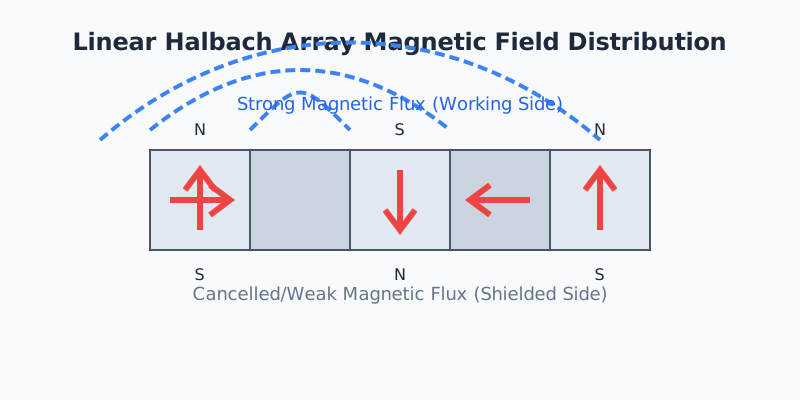
- Working Side (Concentrated Flux): The magnetic field on one side of the array is significantly enhanced.
- Shielded Side (Canceled Flux): The magnetic field on the opposite side is nearly canceled out entirely.
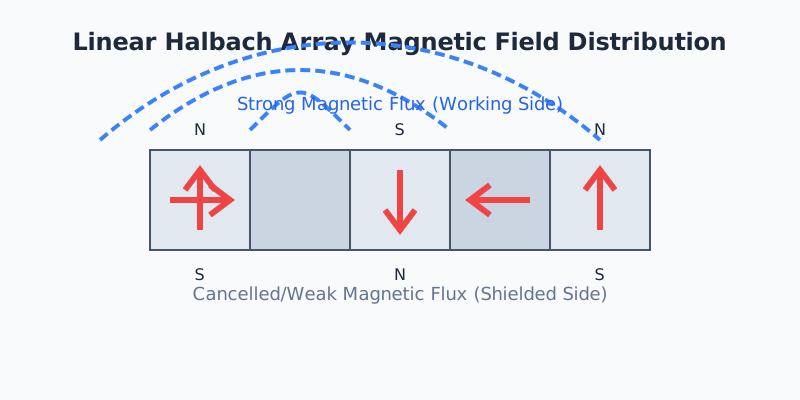 Figure 1: Linear Halbach Array showing the augmented flux on the top working side and the canceled flux on the bottom shielded side.
The "Self-Shielding" Advantage
Because the field is canceled on the back side, Halbach arrays are "self-shielding." This eliminates the need for heavy iron backing plates or yokes traditionally used to contain stray magnetic fields. For weight-sensitive motion systems, high-speed rotors, and robotics, this weight reduction can be a major advantage.
However, this performance comes with extreme assembly challenges. The magnets in a Halbach array are forced into positions where they naturally repel each other with massive force.
Why Manufacturing Costs Are 2–3x Higher
If you are transitioning from standard multipole magnet assemblies to Halbach arrays, expect significant sticker shock. On average, a custom Halbach assembly costs 2 to 3 times more than a conventional magnet assembly of similar volume. This premium is driven by three primary manufacturing hurdles.
1. The Danger of Magnetic Repulsion
In a Halbach configuration, adjacent magnets are oriented to push against each other. The repulsive force (F) between two adjacent magnet segments scales with the square of the magnetic flux density (B) and the interfacial area (A), approximated by Maxwell's stress tensor equation F ≈ (B² * A) / (2 * μ₀). During assembly, these repulsive forces can exceed hundreds of pounds of force for relatively small NdFeB (Neodymium) magnets. If a magnet slips during assembly, it will violently snap into a lower-energy state, instantly shattering the brittle Neodymium material and potentially injuring the assembly technician.
2. Custom Machining and Fixturing
To safely assemble a Halbach array, manufacturers cannot rely on manual labor alone. Custom, non-magnetic fixturing (often precision-machined aluminum or brass) must be built to hold each individual magnet in its exact location while adhesives cure. The cost of designing and milling these one-off assembly jigs is passed directly to the buyer, especially for low-volume production runs.
3. Adhesive and Mechanical Retention Limitations
Because the magnets constantly want to push themselves apart, the long-term structural integrity of the assembly relies entirely on the bonding method. High-strength industrial epoxies are required, but for high-speed rotational applications (like Halbach cylinder rotors), adhesives are not enough. Manufacturers must design mechanical retention systems—such as carbon fiber banding, titanium sleeves, or interlocking magnet geometries—which dramatically increase machining time and material costs.
Planar vs. Cylindrical Halbach Assemblies
When specifying a Halbach array, procurement teams will generally encounter two main topologies, each with distinct sourcing profiles:
Planar (Linear) Halbach Arrays
Used heavily in maglev trains, planar motors, and linear actuators. These are flat tracks of magnets. While easier to assemble than cylinders, planar arrays suffer from severe edge effects. The ends of the array experience massive repulsive forces that require heavy mechanical clamping.
Cylindrical Halbach Arrays (Rotors and Dipoles)
Used in high-efficiency brushless DC (BLDC) motors, MRI machines, and magnetic couplings. The magnets are arranged in a ring.
- Internal Field Cylinders: Concentrate the field inside the bore (used in particle accelerators and NMR spectroscopy).
- External Field Cylinders: Concentrate the field on the outer diameter (used in high-speed electric motor rotors).
Cylindrical arrays are notoriously difficult to manufacture because the magnets must often be wedge-shaped or arc-segmented. Grinding Neodymium into precise arc segments with custom magnetization angles is an expensive, low-yield process.
Critical Tolerances: The Cost vs. Performance Trade-off
The biggest mistake engineers make when designing a Halbach array is over-specifying mechanical and magnetic tolerances. Every micron of precision you demand exponentially increases the scrap rate and final cost.
The table below outlines the trade-offs between standard, precision, and ultra-precision tolerances in Halbach manufacturing.
| Tolerance Category | Standard (Commercial) | Precision (High-Performance) | Ultra-Precision (Advanced Systems) | Cost Impact |
|---|---|---|---|---|
| Dimensional Tolerance | ±0.1 mm | ±0.05 mm | ±0.02 mm | Cost doubles below ±0.05mm due to low grinding yields. |
| Angular Deviation | Commercial target | Precision target | Advanced project target | Requires specialized magnetizing coils; massive impact on field uniformity. |
| Air Gap Between Magnets | < 0.2 mm | < 0.1 mm | Zero Gap (Bonded) | Zero-gap requires perfect wedge angles and vacuum epoxy potting. |
| Magnetic Flux Variation | ±8% | ±5% | ±2% | Tight flux tolerances require defined individual magnet pre-testing. |
The Impact of Angular Deviation
In a Halbach array, the magnetization angle is just as important as the physical dimensions. If the magnetization vector is off by just 5 degrees, the field concentration effect degrades significantly. The "shielded" side will start leaking magnetic flux, and the "working" side will experience dead spots. Ensure your supplier uses Helmholtz coils to verify the magnetization angle of every single segment before assembly.
Sourcing Halbach Magnets: A Buyer’s Checklist
Procuring a Halbach assembly is not like buying standard block magnets. If your supplier lacks specific experience in high-repulsion assemblies, the failure rate will be catastrophic. Use this checklist when vetting potential manufacturing partners:
1. Engineering and Simulation Capabilities
- Do they use FEA software? The supplier should be able to validate your design using Finite Element Analysis (FEA) software like COMSOL, ANSYS Maxwell, or EMWORKS before cutting any material.
- Can they predict assembly forces? They must calculate the exact repulsive forces during assembly to design safe fixturing.
2. Quality Control and Testing
- Magnetization Verification Plan: Do they measure magnetic moment and angle deviation before gluing, and is the sampling scope matched to the tolerance target?
- 3D Magnetic Field Mapping: Will they provide a 3D field map of the final assembly to prove the field uniformity matches the FEA simulation?
- Dynamic Balancing: For cylindrical motor rotors, do they offer high-speed dynamic balancing after the magnets are bonded?
3. Assembly and Retention Expertise
- Cleanroom Bonding: Are adhesives applied in a temperature- and humidity-controlled environment to ensure maximum shear strength?
- Containment Solutions: Can they provide carbon fiber wrapping, non-magnetic stainless steel sleeving, or Kevlar banding for high-RPM applications?
- Thermal Testing: Have they accounted for the degradation of the adhesive and the Neodymium's coercivity (Hcj) at your application's maximum operating temperature?
Frequently Asked Questions (FAQ)
Q: Can I use standard block magnets to build a cylindrical Halbach array? A: While possible for very large diameters or low-performance prototypes, standard rectangular blocks will create large, wedge-shaped air gaps when arranged in a circle. These air gaps drastically reduce the magnetic field strength. For professional applications, custom arc-segmented magnets are required.
Q: Why does my Halbach array feel weaker than a standard magnet assembly of the same size? A: Halbach arrays do not generate "more" magnetism; they simply redirect it. If you are measuring the field strength at a distance (far-field), the field drops off much faster than a standard dipole. Halbach arrays are designed for incredibly strong near-field performance. Ensure your air gap (the distance between the array and the stator/coil) is as small as mechanically possible.
Q: Can a Halbach array be magnetized after assembly? A: Generally, no. Because the magnetization vectors of adjacent segments point in completely different directions, it is nearly impossible to create a single magnetizing coil that can magnetize the entire array simultaneously. The individual segments must be fully magnetized before assembly, which is exactly what makes the assembly process so difficult and dangerous.
Q: What grade of Neodymium should I specify? A: Because Halbach arrays force magnets to push against each other, the magnets are constantly subjecting each other to a demagnetizing field. Therefore, you must specify a high-coercivity (SH, UH, or EH) grade of Neodymium. Using a standard N42 or N52 grade without high coercivity may result in the magnets demagnetizing themselves over time, especially at elevated temperatures.
Conclusion
The Halbach array represents a high-value magnetic engineering option. By reducing the need for heavy iron backing plates and concentrating flux where it is needed, it can support the next generation of robotics, scientific instrumentation, and precision motion technologies.
However, the cost of entry is high. The violent repulsive forces during assembly, the need for precision custom fixturing, and the tight tolerances required to achieve uniform fields make Halbach manufacturing a highly specialized discipline. By understanding the cost drivers, balancing your tolerance requirements, and rigorously vetting your suppliers using the checklist provided, procurement teams can successfully navigate the complexities of sourcing these advanced assemblies.
Need Help Sourcing a Halbach Assembly?
Are you struggling to find a reliable supplier capable of handling high-tolerance Halbach magnet assemblies? At Halbach Magnet, our application engineers specialize in transitioning complex magnetic designs from simulation to mass production.
We support FEA validation, controlled custom assembly, and 3D field mapping to help confirm that your array matches the approved design intent.
Contact our engineering team today to discuss your specific application, request a manufacturability review, or get a quote on your custom Halbach assembly.
Sources and References used in compiling this guide:
- Advanced Magnetic Materials and Applications, Journal of Magnetism and Magnetic Materials.
- Assembly Challenges in High-Performance Permanent Magnet Rotors, IEEE Transactions on Magnetics.
- Tolerance Sensitivity in Halbach Array Manufacturing, International Conference on Electrical Machines (ICEM).
- Adhesive Retention in High-Speed Magnetic Assemblies, Industrial Adhesives Review.
- Demagnetization Risks in High-Coercivity Neodymium Magnets, Material Science and Engineering.
Author

Categories
More Posts
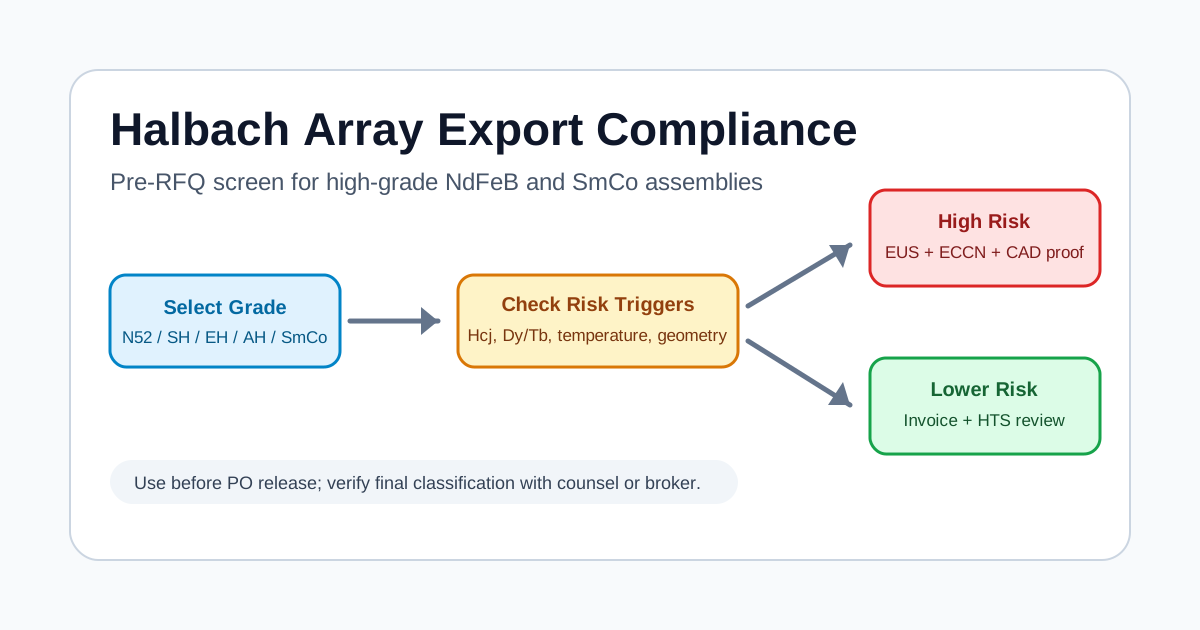
Navigating Export Controls and Dual-Use Compliance for High-Grade Halbach Arrays
Procurement guide to sourcing high-grade NdFeB and SmCo Halbach arrays without dual-use export control delays, customs seizures, or legal penalties.
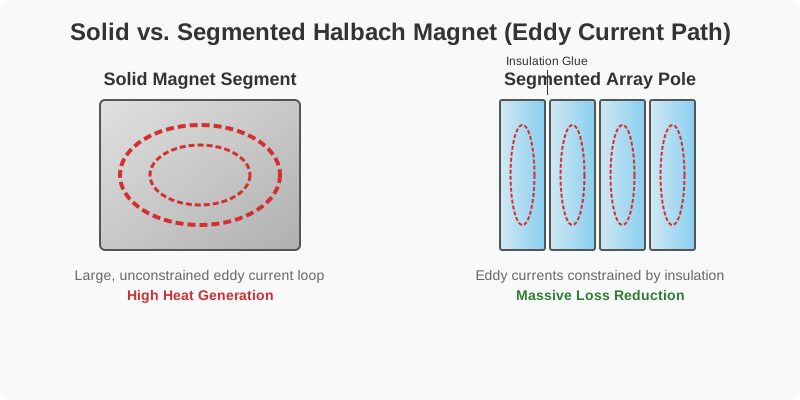
Segmented Halbach Arrays vs. Solid Rings: Managing Eddy Current Losses and Sourcing Costs
Compare segmented Halbach arrays and solid rings for eddy current loss control, sourcing cost trade-offs, and RFQ checks for high-speed magnet rotors.
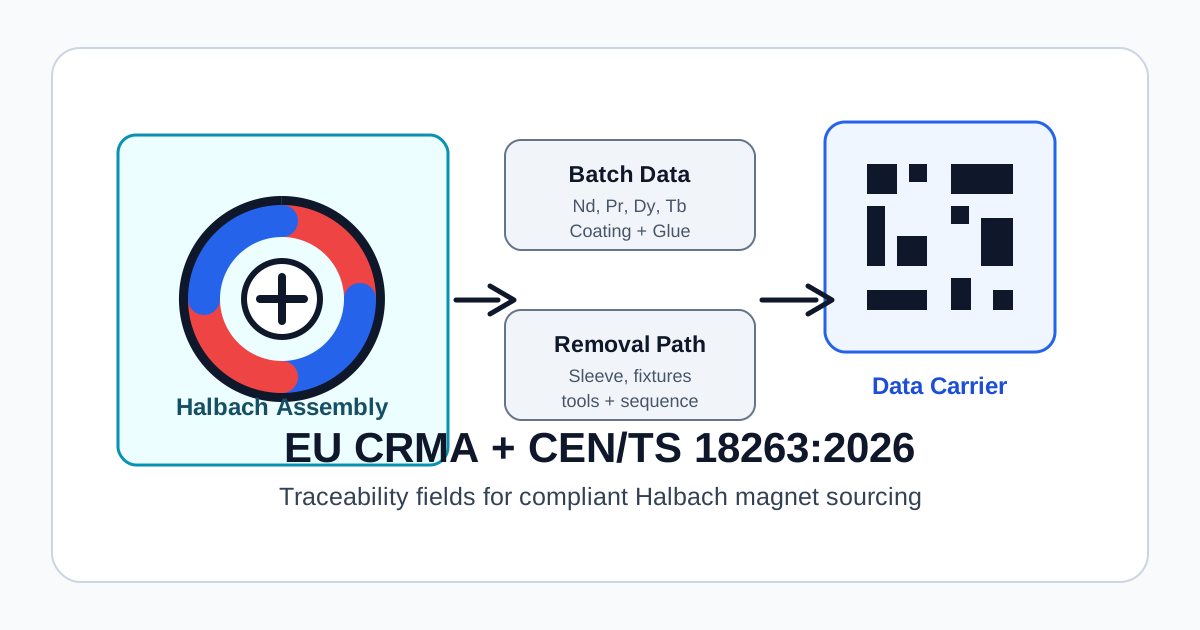
Halbach Array Supply Chain Traceability: Preparing for EU CRMA & CEN/TS 18263:2026
Prepare Halbach magnet sourcing for EU CRMA and CEN/TS 18263:2026 with supplier data fields, recycling risks, RFQ checklist, and contact review steps.