
Halbach Array Manufacturing: Cost vs. Yield in Assembly-First vs. Magnetize-Later Techniques
Compare Halbach array assembly-first vs magnetize-later manufacturing by cost, yield, grade limits, supplier checks, and RFQ timing.
Halbach Array Manufacturing: Cost vs. Yield in Assembly-First vs. Magnetize-Later Techniques
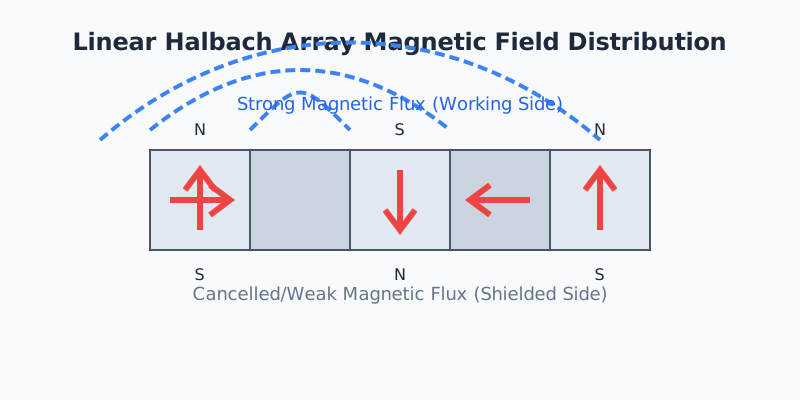
For decades, the standard procedure for manufacturing Halbach magnet arrays has been a violent, labor-intensive, and inherently dangerous process. Engineers rely on Halbach configurations—which concentrate magnetic flux on one side while canceling it on the other—to power everything from high-speed electric vehicle (EV) motors to portable MRI machines.
However, sourcing these assemblies has traditionally meant paying a massive premium. The classic manufacturing method requires magnetizing individual Neodymium blocks before forcing them together. Because adjacent magnets in a Halbach array are designed to violently repel one another, factories must build expensive, custom non-magnetic jigs just to glue the pieces together without shattering them.
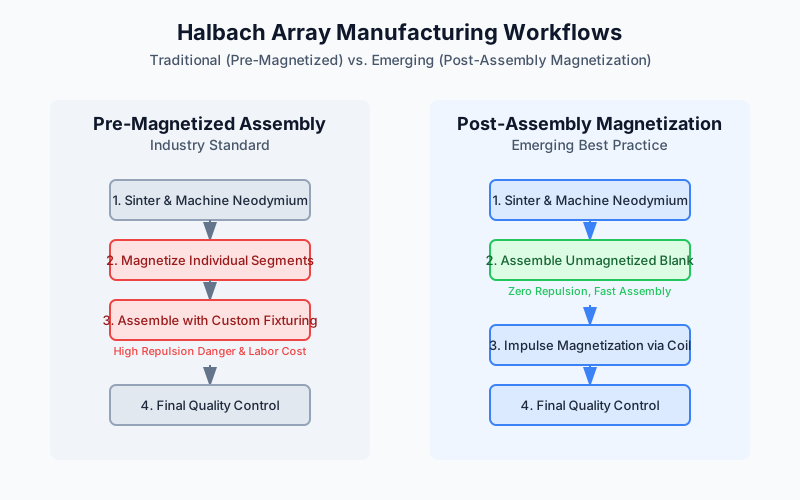
In recent years, a major paradigm shift has emerged: Post-Assembly Magnetization, often referred to as "Magnetize-Later" or "Assembly-First" techniques. Instead of wrestling with pre-magnetized blocks, advanced manufacturers assemble unmagnetized "blank" rotors and use specialized high-voltage impulse coils to magnetize the entire array simultaneously.
For procurement teams, mechanical engineers, and hardware supply chain managers, understanding this shift is critical. In this deep dive, we compare traditional pre-magnetized assembly against post-assembly magnetization, examine the impact on yield rates and unit costs, and provide a sourcing checklist to help you identify which suppliers can actually deliver on these new promises.
Scope and date note: This guidance is current as of July 7, 2026 and applies to custom NdFeB Halbach cylinders, rotors, and linear tracks where the buyer can influence magnet grade, pole count, tolerances, validation method, and production volume. It is not a substitute for supplier-specific magnetic FEA, thermal analysis, pull-force safety review, or final field mapping.
The Core Problem: The True Cost of Pre-Magnetized Assembly
To understand why the industry is moving away from the old standard, we must look at where the costs actually come from in traditional Halbach array manufacturing.
1. The Physics of Repulsion
In a standard dipole assembly, magnets naturally want to snap together. In a Halbach array, the magnetization vectors of adjacent segments are deliberately rotated (often by 45 or 90 degrees). This creates massive repulsive forces. A technician attempting to place a 2-inch Neodymium (NdFeB) segment into a cylindrical rotor is fighting hundreds of pounds of shear force. If the magnet slips, it snaps into a lower energy state. Because sintered NdFeB is essentially a brittle ceramic, this snap shatters the magnet instantly, turning a $50 component into useless shrapnel.
2. Custom Machined Assembly Jigs
To prevent this shattering, manufacturers cannot rely on human hands. They must design and CNC-machine complex, non-magnetic fixturing (usually brass or aluminum) for every single rotor design. The jig holds magnet #1 in place, then slowly leverages magnet #2 into position while epoxy cures.
- The Cost Impact: If you are ordering a prototype run of 10 rotors, the cost of designing and machining the assembly jig is amortized across just 10 units, artificially inflating your prototype cost by thousands of dollars.
3. Worker Safety and Yield Rates
Even with the best jigs, the process is dangerous and prone to failure. Adhesives can fail during the curing process, or a slight misalignment can cause the jig to bind. For RFQ screening, many buyers model traditional high-tolerance cylinder assembly with a 15% to 25% scrap allowance until the supplier provides its own lot-level yield data. You, the buyer, are paying for those shattered magnets.
The Paradigm Shift: Post-Assembly Magnetization
Driven by the need for mass-market high-speed EV motors and lightweight aerospace components, researchers and leading factories have refined the Post-Assembly Magnetization process.
How It Works
- Sintering and Machining: The Neodymium is formed, cut, and ground into the required arc segments or wedges, just like the traditional method.
- Assembly (Unmagnetized): The completely inert, unmagnetized metal blocks are glued and mechanically retained (e.g., carbon fiber sleeved) into the final rotor or linear track shape. Because there is zero magnetic repulsion, this process is incredibly fast, safe, and requires no heavy-duty custom jigs.
- Impulse Magnetization: The finished, cured assembly is placed inside a highly specialized, custom-wound magnetizing fixture. A massive capacitor bank discharges a high-current pulse through the fixture for a few milliseconds. The fixture's coil geometry generates a spatially rotating magnetic field that permanently magnetizes the rotor into a Halbach pattern in a fraction of a second.
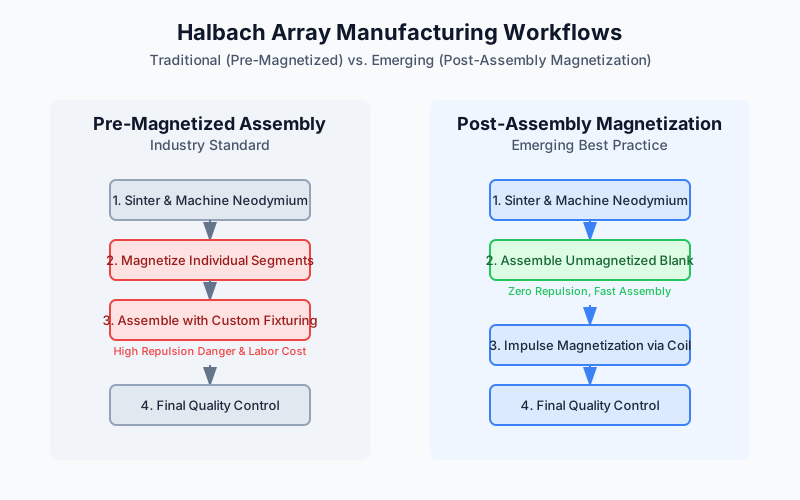 Figure 1: Comparison of the traditional pre-magnetized workflow versus the emerging post-assembly magnetization workflow.
The Limitations: Why Isn't Everyone Doing It?
If "magnetize-later" is so superior, why do many suppliers still use the old method?
- Fixture Complexity: Designing the magnetizing coil fixture requires advanced multiphysics FEA simulation. The coil must perfectly match the desired Halbach pole count.
- Material Coercivity Limits: It is notoriously difficult to fully saturate high-coercivity grades (like UH or EH grades of Neodymium) through post-assembly magnetization. The magnetic field required to push these grades to saturation is so immense that it risks melting the magnetizing coil itself.
- Capital Expenditure: The capacitor banks required for whole-rotor magnetization cost hundreds of thousands of dollars. Only top-tier magnetic manufacturers have this equipment.
Cost and Yield Trade-Offs: A Procurement Comparison
For buyers, the decision between these two methods ultimately comes down to volume, grade, and upfront tooling budgets. The following trade-off table is an RFQ planning model, not a universal guarantee: ask each supplier to replace these ranges with its own lot history, inspection plan, and field-map evidence.
| Sourcing Metric | Pre-Magnetized Assembly (Traditional) | Post-Assembly Magnetization (Emerging) | Buyer Implications |
|---|---|---|---|
| Upfront Tooling Cost | Moderate (Custom brass/aluminum holding jigs) | High (Custom 3D-wound magnetizing coils) | Traditional is cheaper for low-volume prototypes (1-10 units). |
| Unit Labor Cost | High (Slow, dangerous manual or semi-auto assembly) | Low (Fast, safe assembly of inert metal blocks) | Magnetize-later scales infinitely better for mass production (>100 units). |
| Manufacturing Yield | 75% - 85% (High risk of shattering during gluing) | 95%+ (Zero repulsion during mechanical assembly) | Buyers pay for scrap. High yields drastically lower long-term unit price. |
| Adhesive Integrity | Variable (Magnets fight the glue while it cures) | Excellent (Zero stress on joints during curing) | Magnetize-later provides better structural integrity for 100,000+ RPM rotors. |
| Magnet Grade Support | All Grades (Even ultra-high coercivity AH/EH) | Limited (Best for N, M, H, SH grades) | If your application runs at 200°C, traditional assembly may be mandatory. |
| Dimensional Accuracy | Good (Subject to glue thickness variations) | Excellent (Can be final-ground before magnetizing) | Magnetize-later allows for post-assembly precision grinding. |
| Validation Burden | Moderate (Segment polarity and final field inspection) | High (Fixture proof, saturation proof, and final 3D field map) | Do not accept magnetize-later claims without field-map evidence. |
Evaluating Suppliers: The Procurement Checklist
When sourcing a Halbach array in 2026, you must actively interrogate your supplier's capabilities. Do not assume they will use the most efficient method. Use this checklist to evaluate whether a supplier is capable of delivering high-yield, cost-effective magnetize-later assemblies.
- 1. Coil Simulation Capabilities: Can the supplier show you the FEA simulation of the magnetizing fixture? They must prove the fixture can generate a field strong enough (usually > 3.0 Tesla) to saturate the specific grade of Neodymium you selected.
- 2. Capacitor Bank Capacity: Ask about the joule rating and peak amperage of their impulse magnetizers. Post-assembly magnetization of a Halbach array requires significantly more energy than a simple diametric rotor.
- 3. Post-Magnetization Field Mapping: Because the array is magnetized all at once, you must verify the field is uniform. Does the supplier provide a 3D magnetic field map of the final part to prove the poles are perfectly aligned?
- 4. High-Coercivity Alternatives: If your design requires an EH or AH grade magnet (operating > 150°C), ask the supplier if they have successfully post-magnetized that specific grade before. If not, pivot back to traditional pre-magnetized assembly to ensure full magnetic saturation.
- 5. Dynamic Balancing Protocol: If you are buying a rotor, ensure they dynamically balance the assembly after the magnetization step, as the magnetic field can interact with balancing equipment.
- 6. Production Breakpoint: Ask for separate pricing at prototype, pilot, and production volumes. The right method usually changes once the coil fixture cost can be amortized across a larger run.
Real-World Applications and Sourcing Strategy
How do these manufacturing techniques apply to real-world engineering challenges? Let's look at three distinct scenarios.
Electric Aviation and Drone Propulsion
Weight is everything in aviation. Engineers use Halbach arrays to strip away the heavy iron back-iron in BLDC motors. For these high-volume, lightweight rotors, Post-Assembly Magnetization is the ideal path. The ability to assemble the rotor safely and even apply a carbon-fiber retaining sleeve before magnetization ensures absolute structural integrity at high RPMs, reducing supply chain risks for aerospace OEMs.
Portable Medical Imaging (MRI/NMR)
The push for portable MRI machines relies heavily on highly uniform, finite-sized Halbach cylinders. Because these medical devices often use very large magnet segments, the repulsive forces during traditional assembly are lethal. While post-assembly magnetization of large-bore MRI arrays requires massive factory infrastructure, it is becoming the standard for reducing the cost of portable medical imaging hardware.
High-Temperature Industrial Pumps
For industrial magnetic couplings operating in highly corrosive, 200°C environments, engineers must specify ultra-high coercivity magnets (like N35EH). Because current magnetize-later coils struggle to generate the 4.0+ Tesla pulse required to saturate EH material, procurement teams should stick to Pre-Magnetized Assembly. Focus negotiations on tooling costs and accept that unit labor will remain high.
Fast Decision Rule
Use pre-magnetized assembly when you are buying fewer than 10 prototypes, specifying EH/AH temperature grades, or need a supplier to prove performance without funding a dedicated coil fixture. Use post-assembly magnetization when the design is moving into pilot or production volume, the grade can be saturated by the supplier's fixture, and the business case depends on repeatable assembly yield rather than one-off tooling savings. For ambiguous cases, request both quotes and require each supplier to separate tooling, scrap allowance, inspection, and field-mapping costs.
Frequently Asked Questions (FAQ)
Q: Does post-assembly magnetization result in a weaker Halbach array?
A: No, provided the magnetizing fixture is designed correctly and the capacitor bank has enough energy. If the Neodymium is fully saturated, the final magnetic field will be identical to an array built from pre-magnetized blocks. However, if the factory's equipment is underpowered, the array will be "under-magnetized," leading to severe performance drops. This is why requesting a 3D field map is critical.
Q: Can a post-magnetized rotor be repaired if a segment is damaged?
A: Generally, no. Once a rotor is magnetized and epoxied, removing a single segment without damaging the surrounding magnets is incredibly difficult. This applies to both traditional and magnetize-later assemblies. The entire unit is usually scrapped.
Q: We are only building 5 prototype rotors. Which method should we specify?
A: For low volumes, stick to traditional Pre-Magnetized Assembly. The cost of machining a custom brass gluing jig is much lower than the cost of winding a custom copper magnetizing coil. Transition to the magnetize-later method only when you are preparing for pilot production (100+ units).
Q: Can we use standard rectangular blocks for a magnetize-later Halbach cylinder?
A: While possible, using rectangular blocks creates air gaps. If you are investing in post-assembly magnetization, you should specify true arc-segmented wedges. Because they are assembled unmagnetized, handling arc segments is much easier and allows for a true "zero-gap" construction, maximizing field strength.
Conclusion: Adapting Your Supply Chain
The transition from pre-magnetized assembly to post-assembly magnetization represents the most significant cost-reduction opportunity in the permanent magnet industry today. By eliminating the dangers of magnetic repulsion, drastically reducing scrap rates, and speeding up labor, factories can finally produce Halbach arrays at commercial scale.
However, this technology is not a silver bullet. It requires massive capital investment from the supplier and is currently limited by the coercivity of the magnet grade. Procurement teams must move beyond simply comparing unit prices and start auditing their suppliers' factory floors. If your supplier cannot simulate and execute post-assembly magnetization, you may be paying a hidden "danger tax" on every rotor you buy.
By leveraging the checklist and trade-off matrices provided above, you can align your sourcing strategy with the specific volume and temperature requirements of your project, ensuring you get the performance of a Halbach array without the traditional manufacturing premium.
Optimize Your Halbach Array Manufacturing
Are you transitioning a Halbach rotor design from prototype to mass production? Navigating the complexities of assembly techniques, magnet grades, and tooling costs requires specialized expertise.
At Halbach Magnet, we evaluate every custom assembly project to determine the most cost-effective manufacturing route, whether that is precision pre-magnetized assembly for ultra-high temperature applications or advanced post-assembly magnetization for high-volume EV rotors. You can also review our manufacturing capabilities, Halbach cylinder options, and quality-control process before sending an RFQ.
For designs where pre-magnetized blocks remain unavoidable, our safe assembly tooling review helps identify fixture, adhesive, and operator-safety risks before prototype release.
Reach out to our engineering and procurement support team today to review your CAD files, discuss your volume requirements, and receive a manufacturability assessment.
Sources & References
- Li Xia, Yiliang Lv, Leiyi Lv, Zhang Tu, Ronggang Chen, and Liang Li, Design of Post-Assembly Magnetization System of the Rotor of Disk Coreless Permanent Magnet Motor Based on Halbach Array, IEEE CIYCEE 2023.
- Yiliang Lv, Dong Xia, Qingjian Wang, and Liang Li, Post-assembly magnetization of high speed PM rotor with metallic sleeve, ICEMS 2017.
- Ren Zhiyuan and Liu Tianyun, Structural Optimization of External Rotor Permanent Magnet Motor Based on Halbach Magnetization, American Journal of Electrical Power and Energy Systems.
- Magnet Applications, Halbach Magnetizing Fixture, supplier capability reference for fixture-led magnetization.
Author

Categories
More Posts
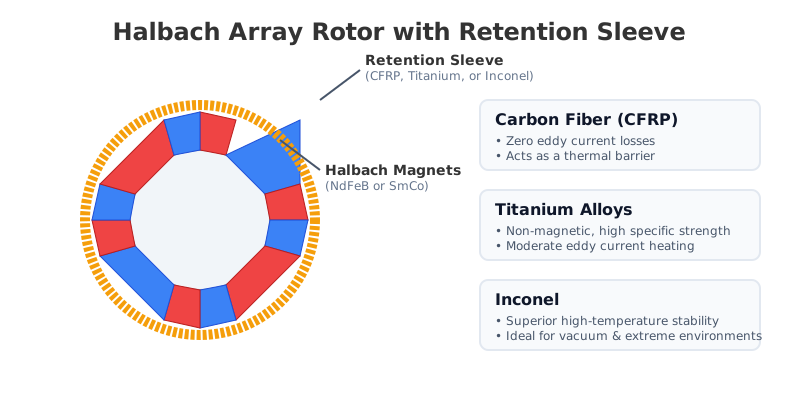
Halbach Array Rotor Retention Sleeves: Carbon Fiber vs. Titanium vs. Inconel
Compare Halbach rotor retention sleeves for high-speed motors: CFRP, titanium, and Inconel trade-offs for eddy losses, thermal limits, and RFQs.
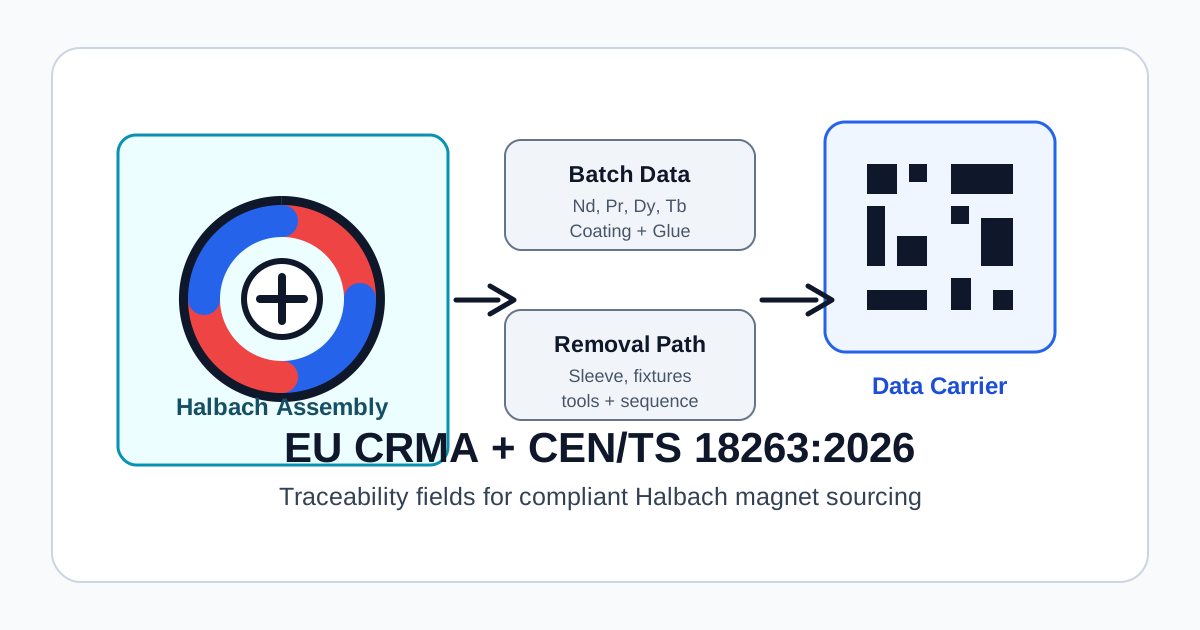
Halbach Array Supply Chain Traceability: Preparing for EU CRMA & CEN/TS 18263:2026
Prepare Halbach magnet sourcing for EU CRMA and CEN/TS 18263:2026 with supplier data fields, recycling risks, RFQ checklist, and contact review steps.
The Engineer’s Guide to Halbach Magnet Assemblies: Costs, Tolerances, and Sourcing Checklist
A comprehensive guide for engineers and procurement teams on sourcing Halbach magnet assemblies, balancing tolerances, manufacturing costs, and structural integrity.