
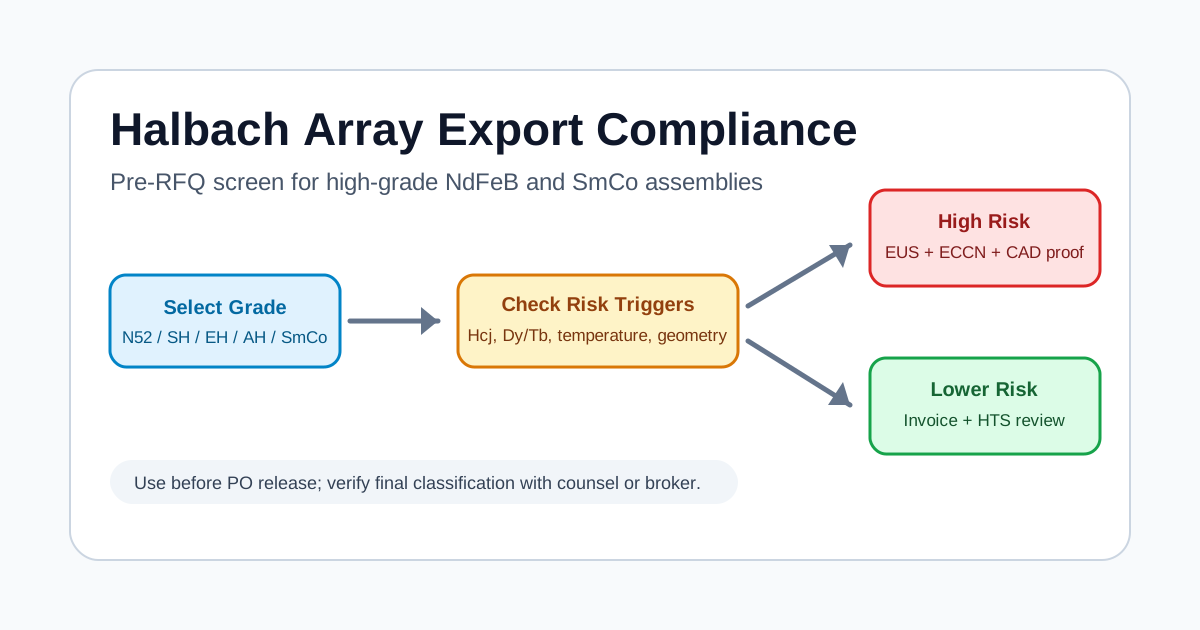
Navigating Export Controls and Dual-Use Compliance for High-Grade Halbach Arrays
Procurement guide to sourcing high-grade NdFeB and SmCo Halbach arrays without dual-use export control delays, customs seizures, or legal penalties.
Navigating Export Controls and Dual-Use Compliance for High-Grade Halbach Arrays
When mechanical engineers specify a Halbach array for a next-generation hardware project, their primary concerns are usually magnetic flux concentration, shear forces during assembly, and thermal demagnetization limits. They focus on the physics. However, for the procurement teams tasked with actually sourcing these complex magnetic assemblies globally, an entirely different, less visible, and often more disruptive bottleneck exists: Dual-Use Export Controls.
As industries like electric aviation, portable medical imaging, and high-speed industrial automation push the boundaries of magnetic performance, the materials required—specifically high-coercivity Neodymium Iron Boron (NdFeB) and Samarium Cobalt (SmCo)—increasingly fall under strict international regulatory scrutiny. The very same magnetic properties that allow a Halbach cylinder to drive a commercial drone motor efficiently also make it highly suitable for restricted aerospace, defense, and military applications.
When a high-performance Halbach rotor gets flagged at customs as a potential "dual-use" item, the resulting delays can fracture production schedules, turning a standard Design Validation Test (DVT) phase into a multi-month legal quagmire. In severe cases, failure to provide proper traceability and end-user documentation can result in permanent seizure of the goods and severe financial penalties for the importing company.
This deep dive is designed for hardware supply chain managers, procurement officers, and engineering leads. We will dissect exactly what triggers these compliance alerts, how different magnetic materials are categorized, and how to structure your Requests for Quotation (RFQs) and Purchase Orders (POs) to ensure seamless, legally compliant global sourcing of advanced Halbach magnet assemblies.
Scope and compliance boundary: Last reviewed on 2026-07-23 for global procurement planning of high-grade NdFeB and SmCo Halbach arrays. Use it as a pre-RFQ screening framework, not as legal advice, an official Export Control Classification Number (ECCN) determination, or a substitute for your customs broker, export counsel, or licensing authority. National control lists, sanctions, end-user rules, and licensing thresholds can change; verify the final classification before purchase order release.
The Intersection of Magnetic Physics and International Law
To understand why a magnet gets stopped at the border, you have to understand the criteria export control authorities (such as the US Bureau of Industry and Security, or European equivalent agencies operating under the Wassenaar Arrangement) use to classify materials. They do not care about your specific consumer product; they care about the potential of the material.
What Makes a Halbach Array "Dual-Use"?
The term "dual-use" refers to technology, software, or materials that have both civilian and military applications. The determination often hinges on a specific decision tree comparing required operating parameters against international thresholds.
In the context of permanent magnets and Halbach arrays, customs authorities evaluate several critical performance metrics:
- Intrinsic Coercivity (Hcj): This is the magnet's resistance to demagnetization. Military and advanced aerospace applications operate in extreme environments. Therefore, magnets with exceptionally high coercivity (like the AH and EH grades of Neodymium, or virtually all SmCo grades) are heavily monitored. If your commercial high-speed pump requires an N42AH grade magnet to survive 220°C operating temperatures, you are inadvertently ordering a material grade capable of military use.
- Heavy Rare Earth (HRE) Content: To achieve high coercivity, manufacturers must alloy standard Neodymium with Heavy Rare Earth elements, primarily Dysprosium (Dy) and Terbium (Tb). Because the global supply chain for Dy and Tb is highly concentrated and strategically sensitive, bulk shipments of high-HRE content magnets are strictly tracked.
- Remanence (Br) and Energy Product (BHmax): Ultra-high energy product magnets (e.g., N52, N54) offer maximum flux density in minimal volume. While great for a consumer smartphone actuator, this high energy density is also requisite for specialized defense targeting systems.
- Precision Assembly and Field Homogeneity: Halbach arrays are not just raw materials; they are highly engineered sub-assemblies. A Halbach cylinder designed for a portable Nuclear Magnetic Resonance (NMR) device requires extreme spatial field homogeneity (often measured in parts per million). This level of manufacturing precision elevates the assembly from a simple "magnet" to a "precision scientific instrument component," subjecting it to entirely different Harmonized Tariff Schedule (HTS) codes and Export Control Classification Numbers (ECCN).
The Material Matrix: Compliance Burden by Magnet Grade
Not all Halbach arrays face the same regulatory scrutiny. The friction you will experience in procurement scales directly with the material grade specified by your engineering team. If your engineers over-specify the temperature rating "just to be safe," they may be unwittingly triggering a massive compliance headache.
The following table breaks down the typical compliance burden and export risk associated with different magnet grades commonly used in Halbach arrays.
| Material Category | Typical Grades | Max Operating Temp (°C) | HRE Content (Dy/Tb) | Export Control Risk Level | Common Commercial Use Cases | Compliance Friction Point |
|---|---|---|---|---|---|---|
| Standard NdFeB | N35 - N52, N35M - N50M | 80°C - 100°C | None to Very Low | Low | Consumer electronics, standard BLDC motors | Standard commercial invoice and basic HTS classification usually suffice. |
| High-Temp NdFeB | N35SH - N45SH | 150°C | Moderate (1-3%) | Moderate | EV traction motors, industrial servos | May require basic End-User Statement (EUS) depending on the exporting country's current quotas. |
| Ultra-High Temp NdFeB | N33EH - N38EH, N30AH - N35AH | 200°C - 230°C | High (4-8%+) | High | High-speed rotors, aerospace actuators | Almost always triggers dual-use scrutiny. Strict EUS, company profile, and CAD drawing reviews required. |
| Samarium Cobalt (1:5) | SmCo5 series | 250°C | None (but relies on Sm and Co) | High | Specialized sensors, downhole drilling | Cobalt is a monitored strategic metal. High risk of supply chain audit regarding ethical sourcing. |
| Samarium Cobalt (2:17) | Sm2Co17 series | 300°C - 350°C | None (but relies on Sm and Co) | Extreme | High-performance aviation, satellite components | Subject to intense export licensing. Procurement timelines can be delayed by 4-8 weeks purely for documentation clearance. |
| Bonded NdFeB | Isotropic / Anisotropic Bonded | 120°C - 150°C | Low | Low | Small precision stepper motors | Generally flies under the radar due to lower overall energy product compared to sintered variants. |
Procurement Tip: Always challenge your engineering team if they specify EH, AH, or SmCo grades. Ask: "Can we cool the rotor actively instead of paying the financial and compliance premium for high-temp magnetic materials?"
The Procurement Bottleneck: When Customs Seizes Your Rotor
What actually happens when a shipment of high-grade Halbach arrays is flagged? The process is opaque, highly bureaucratic, and completely blind to your production deadlines.
Typically, the freight forwarder (e.g., DHL, FedEx, or a specialized heavy freight carrier) will issue an exception notice stating the goods are held pending regulatory review. The customs authority has flagged the HTS code or the material description (e.g., "Sintered Neodymium Magnetic Assembly - N45EH") and is demanding proof that the ultimate end-user is not a sanctioned entity or a defense contractor operating outside approved channels.
At this point, the burden of proof falls on you, the buyer, and your supplier. You must quickly produce a dossier that typically includes:
- A detailed End-User Statement (EUS) signed by an executive at your company, swearing under penalty of perjury that the magnets will only be used for civilian purposes.
- A Company Profile detailing your commercial product lines.
- Technical Drawings (CAD) of the final product assembly proving the magnets fit into a commercial device (like an MRI machine or an industrial pump) and not a restricted application.
- A detailed Commercial Invoice that explicitly lists the ECCN.
If your supplier is a low-tier manufacturer unused to exporting high-grade materials, they will not know how to help you. They might have misclassified the HTS code to begin with to save on tariffs, which only makes the customs authority more suspicious. A standard customs hold for dual-use verification can easily stretch from 14 to 45 days. If you are building a pilot run of 50 prototypes, a 45-day delay is catastrophic.
Supplier Qualification: The Export Compliance Checklist
To prevent your supply chain from grinding to a halt, you must audit your Halbach array supplier for export compliance competence before you issue the Purchase Order. Do not rely on generic freight forwarders to handle the nuances of magnetic material export law.
Use this checklist during your supplier vetting process, specifically when sourcing SH, UH, EH, AH, or SmCo grades:
- 1. ECCN Classification Competence: Can the supplier explicitly state the Export Control Classification Number (ECCN) for the specific grade and geometry of the Halbach array you are ordering? If they say "it doesn't need one," that is a massive red flag.
- 2. End-User Statement (EUS) Integration: Does the supplier proactively ask you for an EUS during the quoting phase for high-grade materials? Proactive suppliers know this is a requirement and get the paperwork done before manufacturing begins.
- 3. Traceability of Heavy Rare Earths: Can the supplier provide lot-level traceability back to the raw material separation plant? If customs asks to prove the Dysprosium was not sourced from a sanctioned entity, your supplier must be able to produce the chain of custody.
- 4. Dedicated Export/Logistics Team: Does the manufacturer have an in-house logistics team experienced in high-tech exports, or do they just hand boxes to a local courier? You need a supplier who can talk directly to customs agents in the exporting country.
- 5. RoHS and REACH Baselines: While separate from dual-use military controls, failure to provide accurate RoHS (Restriction of Hazardous Substances) and REACH (Registration, Evaluation, Authorisation and Restriction of Chemicals) compliance certificates is the easiest way for a shipment of magnetic assemblies to get permanently rejected at European borders. Ensure the supplier has up-to-date, third-party verified certificates.
- 6. Experience with Custom Assembly Classifications: A Halbach array often contains non-magnetic retaining sleeves (Carbon fiber, Titanium, Inconel) and structural adhesives. The supplier must know how to declare the composite assembly correctly, not just the raw magnetic material.
Procurement Decision Point Table
To formalize the gap between engineering needs and compliance realities, use this decision framework during the sourcing process:
| Sourcing Phase | Decision Point | Action Required | Failure Risk | Responsible Party |
|---|---|---|---|---|
| 1. Specification | Magnet Grade Selection (e.g., N52 vs. N35AH) | Review max operating temperature necessity. Push back if AH/EH grades are over-specified. | Customs seizure due to dual-use classification. | Engineering & Procurement |
| 2. Supplier Vetting | ECCN Competence | Request explicit HTS and ECCN codes during RFQ. | Supplier uses wrong HTS, leading to massive delays and fines. | Procurement |
| 3. Contracting | Incoterms Selection | Opt for FCA or DAP; explicitly assign export licensing responsibility to the supplier. | Buyer gets stuck trying to navigate foreign export controls on their own. | Legal & Procurement |
| 4. Documentation | End-User Statement (EUS) | Prepare a proactive EUS signed by a company executive; include product line details. | 14-45 day delay at customs while documents are retroactively generated. | Management & Logistics |
| 5. Technical Proof | CAD & Assembly Proof | Provide simplified CAD drawings showing the civilian integration (e.g., pump housing). | Authorities reject EUS without physical proof of commercial use. | Engineering |
| 6. Final Acceptance | RoHS/REACH & Traceability | Demand lot-level HRE traceability and up-to-date chemical certificates. | Shipment rejected at European borders for chemical non-compliance. | Quality Assurance (QA) |
Structuring the RFQ and PO to Prevent Delays
Your Request for Quotation (RFQ) should be more than just a 2D drawing and a material grade. To ensure a smooth transaction, embed compliance directly into your sourcing documents.
1. State the End-Use Upfront: In your RFQ package, include a brief paragraph describing the commercial application. For example: "These Halbach rotor assemblies are strictly for use in commercial, civilian HVAC fluid pumps. They will not be used in any aerospace, defense, or nuclear applications." This allows the supplier's compliance team to clear the project immediately.
2. Require HTS and ECCN on Quotes: Mandate that all quotes must include the proposed Harmonized Tariff Schedule (HTS) code and ECCN. This allows your internal logistics team to pre-clear the codes with your local customs broker before the goods even ship.
3. Define Incoterms Carefully: For high-risk, dual-use magnetic materials, consider using FCA (Free Carrier) or DAP (Delivered at Place) terms, and ensure it is explicitly clear who is responsible for export licensing in the country of origin. If you use EXW (Ex Works), you are taking on the entire burden of legally exporting a restricted material from a foreign country—a task you are likely not equipped to handle.
Bridging the Gap Between Engineering and Logistics
The true cost of a Halbach array is not just the price of the Neodymium and the CNC machining of the assembly jigs. The true cost includes the time, risk, and legal overhead required to move that highly engineered, magnetically potent assembly across international borders.
By understanding the triggers for dual-use scrutiny—specifically high coercivity, Heavy Rare Earth content, and extreme temperature stability—procurement teams can anticipate roadblocks. By challenging engineering to justify the need for AH grades or SmCo, you can often design out the compliance risk entirely. And by auditing suppliers against a rigorous export control checklist, you ensure that when you do need the highest performing magnets on the planet, they actually arrive at your loading dock on time.
For the engineering side of the handoff, pair this compliance screen with the axial Halbach array magnetic field calculator, 4-pole Halbach permanent magnet array design guide, active magnetic bearing sizing workflow, and Halbach array product engineering overview before freezing the RFQ package.
If your engineering team is pushing the limits of Halbach array design and you need a manufacturing partner who understands both the multiphysics of magnetic fields and the intricacies of global export compliance, you need a mature supply chain.
Ready to secure a compliant, high-yield supply chain for your next advanced rotor project?
Contact our engineering and procurement specialists today for a comprehensive RFQ review and compliance audit.
Frequently Asked Questions (FAQ)
Q: Are all Halbach arrays considered dual-use?
A: No. The "dual-use" designation depends primarily on the material grade (coercivity, energy product, HRE content) and the specific tolerances/homogeneity of the assembly, rather than the Halbach configuration itself. A standard N42 Halbach array for a commercial motor is rarely flagged, whereas an N35EH array almost certainly will be.
Q: Can I use a generic freight forwarder to ship high-grade SmCo Halbach arrays?
A: It is highly discouraged. Generic forwarders often lack the specialized knowledge to navigate the ECCN classifications required for high-grade magnetic materials. If customs flags the shipment, a generic forwarder will simply halt it, whereas a specialized logistics partner will preemptively supply the correct End-User Statements and CAD proofs to prevent the hold.
Q: How long does an End-User Statement (EUS) review typically delay a shipment?
A: If prepared reactively (after customs has held the shipment), it can take 2 to 6 weeks for the authorities to clear the goods. If prepared proactively by a competent supplier and submitted at the time of export filing, the delay can often be reduced to zero.
Q: Why do customs care about the glue or carbon fiber sleeve on the Halbach array?
A: Halbach arrays are composite assemblies. Sometimes, the retaining sleeve (e.g., aerospace-grade carbon fiber or specific titanium alloys) is actually more heavily restricted than the magnet itself. The entire assembly must be classified correctly.
Q: Can altering the Halbach array's structural sleeve mitigate export control risks?
A: Sometimes. If the retaining sleeve fundamentally restricts the array from being used in extreme environments (for instance, using a low-temperature commercial epoxy that would fail in an aerospace application), it can be argued in the EUS that the assembly is strictly for low-temp commercial use, even if the internal magnets possess high coercivity.
Sources & References
- Wassenaar Arrangement on Export Controls for Conventional Arms and Dual-Use Goods and Technologies: The foundational international framework that dictates which high-performance magnetic materials (based on remanence and coercivity) are monitored. Review the control lists here.
- Bureau of Industry and Security (BIS) - U.S. Department of Commerce: Provides the Commerce Control List (CCL) which details specific ECCNs for high-performance magnets and related aerospace assemblies. Access BIS dual-use guidelines.
- European Commission - Dual-Use Trade Controls: Details EU regulations, compliance requirements, and End-User Statement (EUS) standards for exporting sensitive technical materials across borders. Explore EU trade controls.
Author

Categories
More Posts
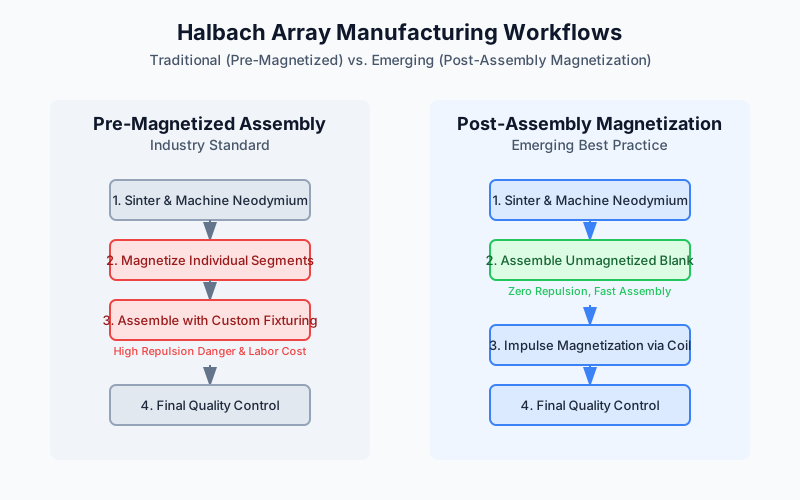
Halbach Array Manufacturing: Cost vs. Yield in Assembly-First vs. Magnetize-Later Techniques
Compare Halbach array assembly-first vs magnetize-later manufacturing by cost, yield, grade limits, supplier checks, and RFQ timing.
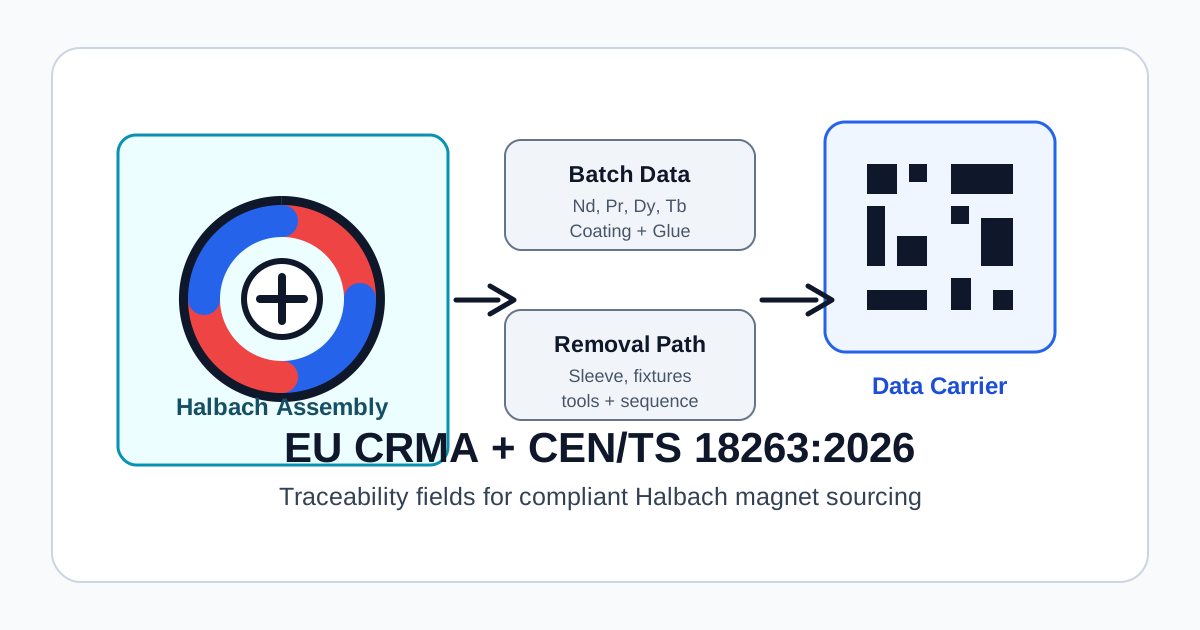
Halbach Array Supply Chain Traceability: Preparing for EU CRMA & CEN/TS 18263:2026
Prepare Halbach magnet sourcing for EU CRMA and CEN/TS 18263:2026 with supplier data fields, recycling risks, RFQ checklist, and contact review steps.
Low-HRE NdFeB vs. SmCo in Halbach Magnet Assemblies: 2026 Sourcing Guide
Compare Low-HRE NdFeB vs SmCo for global Halbach magnet assemblies in 2026. Review temperature limits, supply risks, and RFQ checks before custom sourcing.