
Assembly RFQ tool + supplier guide
Circular Halbach Magnetic Assembly Manufacturer
Prepare a complete ring-assembly request, estimate mass and rim speed, then compare manufacturing and inspection plans.
Published · Reviewed by Halbach Magnet · Planning estimates; project specifications require written confirmation.
Request assembly review →Assembly RFQ builder
Enter ring dimensions for mass, rim speed and an RFQ draft. * Required fields.
What to decide before selecting an assembly manufacturer
1. Specify the assembled result A magnet purchase needs a vector map; an assembly purchase also needs datums, bond lines, retention and a defined field measurement region. Material grade alone is insufficient.[REF-1]
2. Separate balance from strength G1.0 is a requested balance grade, not proof of burst containment, runout or magnetic quality. Rigid and flexible rotor behaviour require different treatment.[REF-2]
3. Ask for process-specific evidence An adhesive data sheet or outgassing result does not qualify the finished assembly. Match substrate, gap, cure and test conditions to the actual application.[REF-3][REF-4]
Choose the supply scope that matches your responsibility
Procurement recommendations below describe what to agree with a manufacturer. They are not audited claims about any factory.
| Scope | Useful when | What remains to qualify |
|---|---|---|
| Loose magnet segments | You have assembly fixtures and internal process control. | Vector identification, handling, bonding, retention and final inspection. |
| Bonded stationary cylinder | Your main task is a defined bore field. | Shimming, mounting, temperature drift and the agreed measurement volume. |
| Retained rotating ring | The ring interfaces with a separately supplied shaft or carrier. | Interface fit, complete rotor dynamics and final assembled balancing. |
| Integrated rotor assembly | One supplier coordinates the mechanical stack. | Drawing approval, proof of process capability and project qualification. |
Calculation method: known quantities and unresolved design questions
The tool uses elementary annular geometry and kinematics. OD and ID describe the magnet ring; the entered sleeve sits outside OD with the same axial length. All estimates describe one ring, including axial topology. No air-gap field is inferred from these dimensions.
| Output | Method (SI units unless stated) | Limits |
|---|---|---|
| Magnet volume | V = π(ro² − ri²)L; cm³ = m³ × 10⁶ | Full annulus; segment gaps, coating and chamfers excluded. |
| Mass estimate | m = ρV; sleeve volume = π[(ro+t)² − ro²]L | Rounded assumed densities: NdFeB 7500, SmCo 8400, Ti 4430, CFRP 1600, 316L 8000, Inconel 8200 kg/m³. Replace with supplier values for final work. |
| Outer-sleeve rim speed | ω = 2πn/60; v = ω(ro+t) | Kinematic value, with no safe-speed or containment inference. |
| Specific unbalance | e_per [µm] = 1000 G/ω | Requested G in mm/s; positive speed and rigid rotor assumption. |
| Total residual unbalance | U_per [g·mm] = e_per [µm] × complete rotor mass [kg] | Mass must include the full rotor. Correction-plane allocation and measurement uncertainty are separate. |
| Field / THD / insertion load / sleeve safety | Not determined | Requires geometry, material and boundary data beyond this tool. |
Balancing conversions follow G = eω.[REF-6] Part 11 concerns rotors with rigid behaviour; the tool does not decide whether your rotor qualifies.[REF-2] Zero RPM or no balance grade yields N/A rather than a false zero tolerance. No complete rotor mass means no total unbalance budget.
Input ranges are software scope limits, not manufacturing capabilities. The minimum 4 segments per pole pair is a screening convention. Grade temperature thresholds are illustrative review prompts, not service limits; actual magnet performance requires supplier curves and the application load line.[REF-1]
Reproduce the default assembly RFQ example
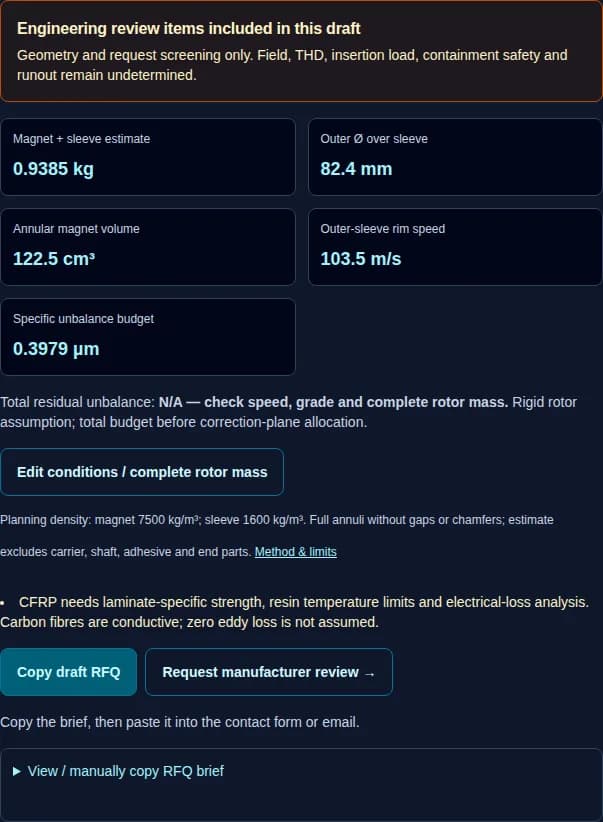
Use Reset Defaults: magnet OD 80 mm, ID 50 mm, length 40 mm, outer sleeve 1.2 mm and speed 24,000 RPM. The screenshot records this tool running on 2026-11-08. Check the annular geometry and outer-sleeve rim speed against the method above, then replace the example inputs with your drawing.
Assembly tooling: request a controlled insertion plan
Pre-magnetized segments can rotate, attract or repel as the assembly sequence changes. A final-position field estimate cannot establish the peak insertion force. Ask for a sequence review with constrained degrees of freedom, shielding and a validated load envelope.[REF-1]
Do not select hand tooling or a hydraulic press from a guessed force threshold. Ask the supplier how the segment is located, how accidental motion is stopped, how adhesive is kept out of datums, and how chipped material is identified and rejected.
Pre-magnetized assembly allows individual vector checks but makes handling harder. Magnetizing after assembly can simplify handling, but pulse access, tooling, saturation and final vector quality must be demonstrated on the actual geometry.
Retention options: compare the failure modes before the material
Retention is a coupled mechanical and thermal design task. A thin-wall pressure estimate cannot establish an interference fit, composite laminate strength, fatigue life or overspeed margin. Specify the entire carrier–magnet–bond–sleeve stack and ask for a project-specific analysis and qualification plan.
| Option | Potential reason to consider it | Evidence to request / alternative |
|---|---|---|
| Metallic outer sleeve | Machinable interfaces and dimensional inspection. | Temperature-dependent properties, interference, stress and electromagnetic heating; compare a qualified composite if loss dominates. |
| CFRP outer sleeve | Low density and directional reinforcement. | Laminate allowables, winding direction, resin limits, electrical losses and inspection for defects; compare a metal if process control is uncertain. |
| Carrier pockets or mechanical capture | Geometry may provide a different retention load path. | Local contact stress, assembly sequence and complete load path; do not assume an outer sleeve is always the only solution. |
| Adhesive-only proposal | May suit an appropriately qualified stationary assembly. | Joint ageing, load case and failure consequence; rotating retention must be justified by the responsible engineer. |
Bonding, thermal behaviour and vacuum requirements
Adhesive selection must account for coating adhesion, surface preparation, joint gap, torque transfer and long-term exposure. Henkel describes LOCTITE 648 as an anaerobic cylindrical retaining compound; that cure mechanism cannot be treated as interchangeable with a two-part epoxy.[REF-4]
NASA’s outgassing guide identifies a screening subset at TML ≤1.0% and CVCM ≤0.10%, and records the sample cure conditions. These are material-screening values, not a promise of zero contamination or proof of UHV service for your assembled magnet.[REF-3]
| Requirement | Record to request | Decision if evidence is missing |
|---|---|---|
| Mechanical bond | Substrate/coating, gap, preparation, cure and representative joint test. | Run a coupon and prototype qualification before freezing the process. |
| Thermal cycling | Temperature extremes, dwell, cycle count and post-test inspection. | Keep thermal durability unconfirmed; do not substitute Curie temperature. |
| Vacuum or optical cleanliness | Exact formulation and cure-specific outgassing record, plus contamination limits. | Treat the assembly as unqualified for the environment until reviewed. |
| Chemical exposure | Fluid, concentration, pressure, temperature and exposure duration. | Check coating, adhesive and any hermetic barrier as a system. |
Acceptance plan: measure separate requirements separately
Finite length, segment geometry and magnetization errors influence the field.[REF-1][REF-5] Agree the region of interest, temperature, probe orientation and sampling before comparing field claims. A Hall map can show field deviations; it does not by itself certify the absence of internal cracks.
| Requirement | Specify on RFQ / drawing | Evidence at acceptance |
|---|---|---|
| Runout and fits | Datum axis, measured surface, assembled state, tolerances and temperature. | Dimensional report with setup and instrument information; no universal TIR is promised. |
| Field amplitude and uniformity | Target component, measurement radius/volume, axial positions and temperature. | Traceable field map, raw samples and uncertainty statement. |
| Harmonic quality | Measurement path, sampling, FFT convention and included orders. | Spectrum from the agreed scan; a segment count does not predict a guaranteed THD. |
| Balance | Complete rotor state, requested G grade, speed, rigid/flexible behaviour and planes. | Residual unbalance by plane with setup, uncertainty and applicable standard. |
| Retention / overspeed | Project load cases, analysis basis, test environment and acceptance criteria. | Approved analysis and test evidence; balancing alone is insufficient. |
ISO 21940-11 covers residual unbalance, correction planes and allocation for rigid behaviour, rather than all aspects of rotor safety.[REF-2]
Manufacturer audit: make quotations comparable
Use the following questions for HalbachMagnet or another circular Halbach magnetic assembly manufacturer. Public evidence on this page does not verify a particular factory’s certifications, equipment, capacity, achievable tolerance, price or lead time. Ask for dated, project-relevant records.
| Audit item | Evidence / quote line | Risk and minimum action |
|---|---|---|
| Process ownership | Who makes magnets, fixtures, sleeves, grinding, balancing and field mapping? | Hidden subcontracting can change capability and schedule; identify each controlled process. |
| Relevant capability | Comparable geometry, vector inspection and anonymized acceptance records. | General magnet experience is insufficient; request a first-article plan. |
| Quality certification | Current certificate, issuing body, scope and site address, if required. | Do not infer ISO 9001 or AS9100 from marketing copy; verify scope and validity. |
| NRE and tooling | Separate fixtures, programming, ownership, storage, maintenance and revision charges. | A low unit price may omit setup and testing; compare total project cost. |
| Lead time and release | Material availability, drawing approval, tooling, sample approval and shipment dates. | No standard SLA is assumed; agree milestones and dependencies in writing. |
| Acceptance and logistics | Inspection records, rework/rejection terms, protected packaging and freight. | Separate recurring inspection from qualification and transport responsibilities. |
Three illustrative sourcing scenarios
These are decision examples, not customer projects or measured performance results.
1. Stationary bore instrument
Premise: the magnet does not rotate and must serve a specified sample volume. Process: select the stationary preset, enter the envelope, then provide the field target, region and temperature range. Result: an RFQ with volume and mass estimates; balance is N/A. Compare suppliers on field mapping and shimming evidence.[REF-1]
2. High-speed motor ring
Premise: OD 65 mm, 1.5 mm outer sleeve and 45,000 RPM, as in the UAV preset. Process: calculate the 160.2 m/s rim speed, record the complete rotor mass separately and request retention and thermal analysis. Result: a kinematic requirement for supplier review; safe speed and sleeve strength remain unknown.
3. Vacuum positioning system
Premise: a bonded circular assembly sits near contamination-sensitive surfaces. Process: identify coatings, exact adhesive, cure and bake conditions, then request matching test records. Result: an evidence checklist and qualification proposal; a generic low-outgassing label does not release the assembly for service.[REF-3]
Assembly, inspection and quotation questions
Scope & inputs
What does this circular assembly tool actually calculate?
One-ring annular volume, nominal magnet and outer-sleeve mass, outer-sleeve rim speed and a requested rigid-rotor balance budget. It prepares a manufacturer RFQ; it does not approve the design.
Why is a magnetic-field value not shown?
Field depends on magnetization direction, air gap or bore measurement region, finite length, material curves and surrounding steel. Supply these details for simulation and agree a measurement plan; envelope dimensions alone do not define the working field.
Can I evaluate an axial dual-ring assembly?
You can record the topology and estimate one annular ring. The second ring, carriers, ring spacing and axial attraction are excluded. Send an assembly drawing for a complete assessment.
Retention & materials
Does choosing CFRP make a rotor safe at any speed?
No. Laminate direction, resin, interference, thermal expansion, defects and fatigue affect retention. Carbon fibres are conductive; loss and temperature rise need application-specific analysis.
Can a magnet grade temperature rating approve the bonded assembly?
No. Supplier B–H curves, the magnetic load line, adhesive ageing, coating and sleeve behaviour must all be reviewed. The tool uses illustrative review thresholds only; it gives no safe operating temperature.
Is LOCTITE 648 interchangeable with a two-part epoxy?
No. Henkel identifies 648 as an anaerobic retaining compound for close-fitting cylindrical assemblies. A different cure mechanism or gap requires a separately qualified bonding process.
Acceptance & evidence
What does G1.0 tell me about runout or burst strength?
It is a balance quality grade. It does not establish geometric runout, mechanical integrity or magnetic uniformity. Specify and verify those requirements separately.
Why is the total residual unbalance budget sometimes N/A?
It requires positive speed, a selected balance grade and the complete rotating mass. The estimated ring-plus-sleeve mass omits the shaft and carrier, so the tool does not substitute it for complete rotor mass. Stationary cases have no rotational budget.
Does ASTM E595 screening mean NASA certified or zero outgassing?
No. NASA records describe material samples under stated cure and test conditions. Match the actual formulation and cure, then define assembly-level contamination requirements for the intended environment.
RFQ & next steps
Which files should I send to a manufacturer?
Send a dimensioned PDF with datums and tolerances, STEP assembly, magnetization map, operating and overspeed requirements, temperature range, field target and measurement region, quantity and acceptance plan. Identify unknowns explicitly.
What price, NRE and delivery time should I expect?
Public evidence on this page does not establish a binding price or schedule. Request separate lines for magnets, tooling, fixtures, assembly, inspection, qualification, packaging and freight. Confirm tooling ownership, revision charges and dates in writing.
How do I submit the generated brief and drawings?
Copy the brief into the contact form or your email. Use the email option on the contact page for drawings and other attachments. If clipboard access is blocked, open the manual-copy brief and select its text.
Sources, dates and evidence boundaries
Links and source identities reviewed on 2026-11-08. Published research supports methods and limitations; it does not establish HalbachMagnet factory capability. Density assumptions and numerical input screens are disclosed planning choices. Recommendations for RFQ and acceptance are procurement guidance, not measured supplier results.
- [REF-1] Blümler & Soltner (2023): Practical Concepts for Design, Construction and Application of Halbach Magnets in Magnetic Resonance
Practical field design, finite geometry, assembly and shimming. Magnetic-resonance focus; does not certify a supplier or a rotating assembly.
- [REF-2] ISO 21940-11:2016 — balancing rotors with rigid behaviour
Official scope: residual unbalance, correction planes, allocation and errors. Flexible rotors are outside Part 11. The catalogue lists Amendment 1:2022; specify the applicable edition in a purchase order.
- [REF-3] NASA Goddard — Outgassing Database User Guide
Explains ASTM E595 screening, TML/CVCM and cure-specific records. Screening data do not demonstrate zero contamination or qualify an entire assembly.
- [REF-4] Henkel — LOCTITE 648 product information
Identifies an anaerobic retaining compound for close-fitting cylindrical parts, not a universal structural epoxy. Joint design, substrate, gap and temperature require product-specific assessment.
- [REF-5] Bjørk (2011): The ideal dimensions of a Halbach cylinder of finite length
Finite-length cylinder study. Supports treating length and end effects as design variables; does not validate a universal length-derating shortcut.
- [REF-6] Spectronics — Balance Quality Grade, theory of operation
Explicit G = eω and U = em unit conversions, with correction-plane limitations. A calculation aid rather than a substitute for the governing balancing standard.
Request a circular Halbach assembly manufacturing review
Copy your generated RFQ brief and paste it into the contact form or email. Include the dimensioned PDF, STEP assembly, vector map, operating conditions, field acceptance requirements, quantity and unknowns. Use the contact page’s email option for drawing attachments.
Ask for a written scope, open technical questions, an inspection proposal and itemized quotation. Capability, certification, NRE, lead time and performance remain subject to project review and written agreement.
Open contact form / drawing email →Return to RFQ tool