
RFQ planning tool + engineering buying guide
Circular Halbach Array Quote & Budget Tool
Configure a magnet envelope, compare an illustrative budget, then copy a specification for a supplier quote. Review what still needs engineering confirmation.
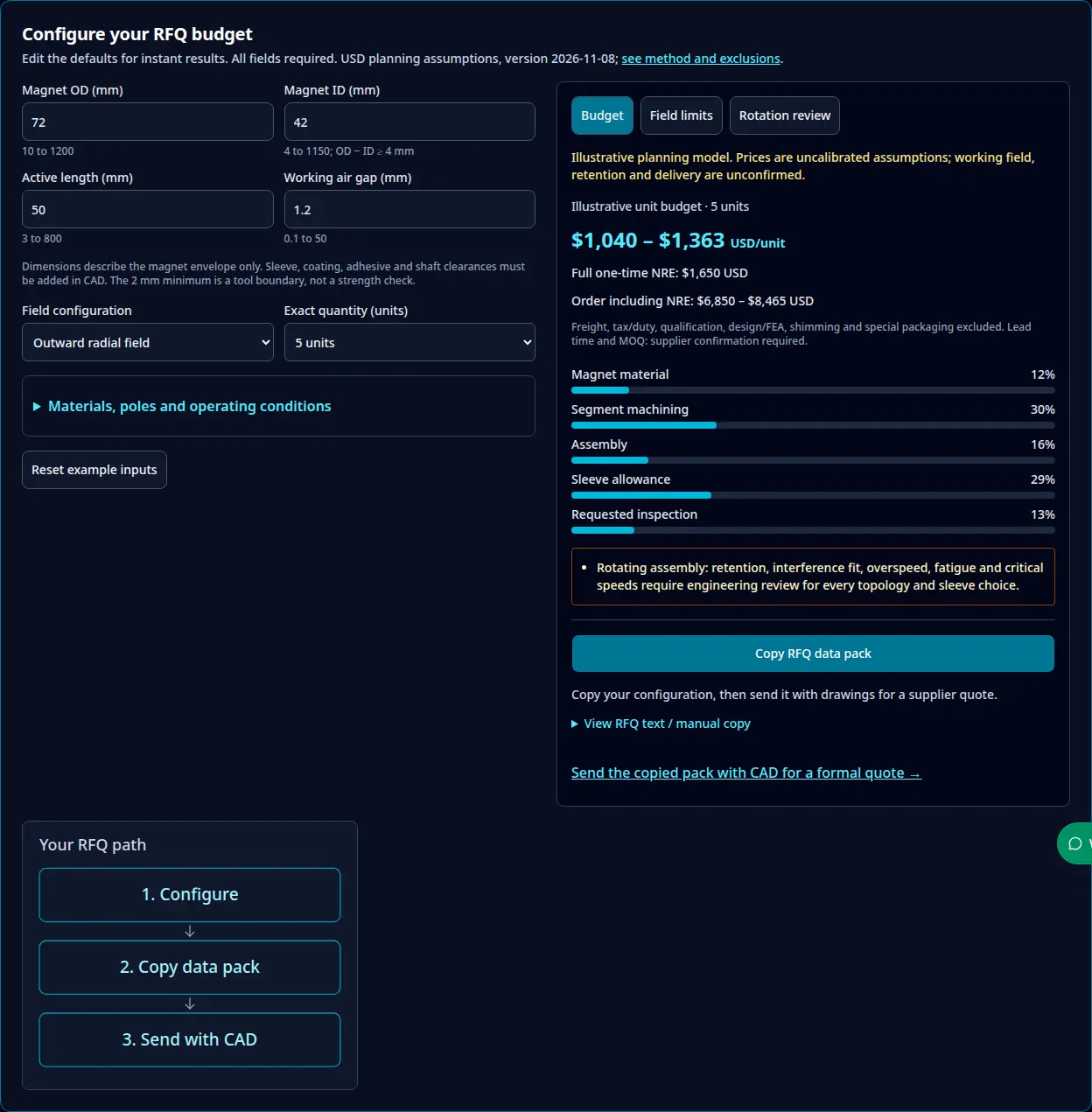
Start your RFQ budget ↓Configure your RFQ budget
Edit the defaults for illustrative USD budgets, not supplier prices. All fields required. Model version 2026-11-08.
Budget method and exclusions10 to 1200
4 to 1150; OD − ID ≥ 4 mm
3 to 800
0.1 to 50
Dimensions describe the magnet envelope only. Sleeve, coating, adhesive and shaft clearances must be added in CAD. The 2 mm minimum is a tool boundary, not a strength check.
Materials, poles and operating conditions
Defaults: N45SH, 2 pole pairs, 16 segments, CFRP, 18000 RPM, 65°C. Inspection and tolerances are requests to confirm.
0 to 150000
-200 to 400
Illustrative planning model. Prices are uncalibrated assumptions; working field, retention and delivery are unconfirmed.
Illustrative unit budget · 5 units
$1,040 – $1,363 USD/unit
Full one-time NRE: $1,650 USD
Order including NRE: $6,850 – $8,465 USD
Freight, tax/duty, qualification, design/FEA, shimming and special packaging excluded. Lead time and MOQ: supplier confirmation required.
View RFQ text / manual copy
1. What to decide before requesting a price
Published 8 November 2026 by Halbach Magnet. Reviewed . Engineering sources support the boundaries below. Commercial values are this page's illustrative assumptions; public evidence for supplier-specific prices, certifications and delivery schedules is insufficient.
Separate budget from acceptance
Unit and NRE allowances help structure a discussion. Agree the field region and test limits before comparing supplier totals. [REF-2]
Define the useful field
A dipole bore field, multipole gradient and motor air-gap waveform are different requirements. Match the observation region to the application. [REF-1]
2. Match the RFQ to the application
| Application | Define in the RFQ | Alternative / limit |
|---|---|---|
| NMR / sensing bore | Mean field and homogeneity over a defined sample volume, temperature and orientation. | If aperture access matters more than compactness, compare split assemblies or other magnet geometries. |
| Motor / generator | Air-gap radius, stack length, stator geometry, waveform and speed range. | Compare conventional radial PM arrangements against required torque, loss and assembly cost. |
| Beam focusing | Gradient in T/m, good-field aperture and allowed multipole errors. | Do not specify dipole centre field for a quadrupole. |
| Axial coupling / thrust | Face gap, load or torque curve, relative position and opposing assembly. | Use a dedicated 3D model; radial cylinder formulas do not apply. |
Field conventions: [REF-1]. Application selection and alternative comparisons above are RFQ recommendations, not simulated performance results.
3. Reproduce the illustrative budget
The budget is deterministic and uncalibrated to supplier quotations. Use it to see which requested scope changes the allowance; do not treat the displayed range as a confidence interval or market price. All monetary assumptions are USD, version 2026-11-08.
| Component | Assumption / formula | Interpretation |
|---|---|---|
| Magnet material | Ideal magnet mass × grade USD/kg × 1.35 | Grade assumptions: N42 68; N52 95; N45SH 88; N38UH 115; N35EH 145; SmCo 165 USD/kg. 1.35 is an allowance multiplier, not measured kerf yield. |
| Machining | M × (8 + 2.5 × L/25) × tolerance factor | L in mm. Tolerance multipliers: commercial 1; precision 1.45; ultra 2.15. No process capability is certified. |
| Assembly | (85 + 4.5 × M) × topology factor | Inward bore factor 1.25; other configurations 1. Fixture effort may differ materially. |
| Sleeve | Base + 35 × (OD/50) × (L/50) | Base: none 0, 316L 75, Ti 185, CFRP 240 USD. No sleeve wall or fit is designed. |
| Requested inspection | Setup / quantity + per-unit allowance | Standard 120 + 15/unit; advanced 450 + 45/unit; custom 950 + 90/unit. Scope and availability to confirm. |
| Quantity and unit range | Component sum × quantity factor × [0.90, 1.18] | Factors for 1/5/25/100/500 units: 1.65/1.15/0.78/0.52/0.38. These are planning assumptions, not offered discounts. |
| One-time NRE | 1200 + 45 × max(M−16,0) + 4 × max(OD−100,0) + sleeve tooling | Sleeve tooling: CFRP +450; Ti +300 USD. Both order endpoints include full rounded NRE. |
| Order range | Rounded unit endpoint × quantity + full NRE | Excludes freight, tax/duty, qualification, design/FEA, shimming and special packaging. Confirm MOQ, quote validity and lead time separately. |
The shares shown in the tool represent the five assumed manufacturing components before quantity scaling, excluding NRE and excluded services. They sum to 100%.
4. Understand the field reference before using it
For inward p=1 only, the continuous infinite-length reference is Br × ln(OD/ID). Equal wedge-sector segmentation multiplies it by sin(2π/M)/(2π/M). The tool uses the illustrative grade Br at 20°C and relative permeability near one. [REF-1] [REF-2]
| Configuration | Available here | Must be established separately |
|---|---|---|
| Inward dipole p=1 | Ideal continuous and segmented 20°C reference. | Finite-length field, temperature behavior, demagnetization and sample-volume homogeneity. |
| Inward multipole p>1 | Budget and specification only; working field N/A. | Field as a function of position; ideal centre is zero. Define gradient/aperture. |
| Outward radial field | Budget, magnet mass and tip speed only. | Field at specified radius, stator/back-iron interactions and harmonic losses. |
| Axial face field | Budget and specification only. | 3D face field, coupling force or torque and opposing geometry. |
What more segments actually change
| Total segments M | sin(2π/M)/(2π/M) | Procurement implication |
|---|---|---|
| 8 | 90.03% | More parts to machine, orient and inspect; harmonic purity still requires measurement. |
| 12 | 95.49% | More parts to machine, orient and inspect; harmonic purity still requires measurement. |
| 16 | 97.45% | More parts to machine, orient and inspect; harmonic purity still requires measurement. |
| 24 | 98.86% | More parts to machine, orient and inspect; harmonic purity still requires measurement. |
| 32 | 99.36% | More parts to machine, orient and inspect; harmonic purity still requires measurement. |
| 48 | 99.71% | More parts to machine, orient and inspect; harmonic purity still requires measurement. |
| 64 | 99.84% | More parts to machine, orient and inspect; harmonic purity still requires measurement. |
5. Finite length: request a field map, not a universal derating
A single L/ID or L/OD ratio cannot define the actual working field and homogeneous volume. Specify both diameters, active length, sample region and any shims or iron. Finite-cylinder optimization depends on the target volume and field. [REF-3]
No fixed finite-length correction is used in this tool. Ask for a 3D model with the drawing revision, material curve, boundary conditions and a map across the working region, followed by a measured acceptance map.
6. Material grade is a request to qualify
| Requested family | Br assumption at 20°C / density | Screening temperature (not an operating guarantee) |
|---|---|---|
| N42 | 1.3 T / 7500 kg/m³ | 80°C; supplier grade and load-line review required |
| N52 | 1.45 T / 7500 kg/m³ | 80°C; supplier grade and load-line review required |
| N45SH | 1.35 T / 7550 kg/m³ | 150°C; supplier grade and load-line review required |
| N38UH | 1.25 T / 7600 kg/m³ | 180°C; supplier grade and load-line review required |
| N35EH | 1.18 T / 7650 kg/m³ | 200°C; supplier grade and load-line review required |
| Sm2Co17 | 1.08 T / 8400 kg/m³ | 350°C; supplier grade and load-line review required |
Obtain demagnetization curves at the actual magnet temperature and assess reverse field with the load line. The page does not model cryogenic behavior or certify a maximum service temperature. Temperature stability and demagnetization require more than a grade name. [REF-2]
Grain boundary diffusion may be a supplier process option. No universal Dy/Tb content, coercivity improvement or percentage saving is assumed; request equivalent test data and comparable quotations.
7. Retention, losses and thermal trade-offs
For any rotating array, request a structural and rotordynamic assessment. This tool calculates magnet-OD tip speed v = π × OD × RPM / 60000 in m/s only. It does not calculate hoop stress, sleeve wall, interference fit or a safe RPM.
| Option | Potential benefit | What to check |
|---|---|---|
| No sleeve | Can simplify a stationary assembly. | If rotating, establish another validated retention method. Adhesive selection alone is insufficient. |
| 316L | Metal containment and manufacturable interfaces. | Exact condition, permeability, yield data, fit and harmonic heating. |
| Ti-6Al-4V | Strength / mass trade-off for metal containment. | Material condition, fit, thermal expansion, machining cost and electromagnetic losses. |
| CFRP | Potentially lower sleeve losses than metal alternatives. | Layup-dependent strength and conductivity, preload, resin temperature limits and heat transfer; magnet losses remain possible. |
A published machine study shows the trade-off between sleeve loss, magnet loss and cooling; it does not establish zero loss for every CFRP rotor. [REF-6] Request coupled loss/thermal analysis using the actual excitation spectrum.
8. Tie tolerances to a measured acceptance condition
| Class | Dimensional request / cost factor | Decision before quotation |
|---|---|---|
| Commercial | ±0.05 mm / 1.00 | Identify which features and drawing datums this applies to. |
| Precision | ±0.02 mm / 1.45 | Specify assembly runout separately from segment size. |
| Ultra | ±0.01 mm / 2.15 | Confirm process feasibility, measurement uncertainty, yield and inspection scope. |
No fixed cogging, THD or homogeneity improvement follows from these class labels. Ask the supplier to allocate dimensional, magnetization and material variation to your magnetic error budget. [REF-2]
9. Bonding, vacuum compatibility and tooling
| Requirement | Useful evidence | Limit / mitigation |
|---|---|---|
| Structural bonding | Exact resin/hardener, bond-line thickness, surface preparation and cure record. | Coupon strength does not qualify the assembled joint; agree load and environmental tests. |
| Low outgassing | Exact material formulation and cure matched to an ASTM E595 record. | NASA lists TML ≤1.0% and CVCM ≤0.10% screening criteria; mission limits may be stricter. |
| Vacuum assembly | Leak rate, pump-down and contamination limits; agreed bakeout conditions. | Material screening does not certify a target chamber pressure. Test the assembly with compatible thermal limits. |
| Tooling ownership | Itemized jigs, setup, storage and repeat-order charges. | Confirm amortization in writing; this tool does not assume future NRE is waived. |
NASA's database distinguishes material and cure/test conditions. No adhesive brand or finished array is declared compliant here. [REF-4]
10. Agree the inspection scope and records
| Requested check | Buyer must define | Evidence to retain |
|---|---|---|
| Dimensional | Datums, interfaces, tolerances and sampling. | Revision-linked dimensional report and measurement method. |
| Magnetic | Working region, coordinate system, temperature, grid and field/harmonic limits. | Calibrated probe information, raw field map and agreed analysis. |
| Balance | Operating/test speed, rotor mass, planes and selected grade. | Residual unbalance report and correction locations. |
| Thermal / vacuum | Temperature cycle, pressure or leak limit, dwell and allowable field change. | Agreed test record; this is separately priced qualification. |
ISO 21940-11 covers rotors with rigid behavior; do not use it as flexible-rotor qualification. A balance grade requires speed and rotor context, rather than a universal g·mm/kg limit. [REF-5]
11. Build a reviewable RFQ package
| Package item | Minimum useful content | If unknown |
|---|---|---|
| Drawing / CAD | OD, ID, L; sleeve and shaft interfaces; revision and datums. | Send envelope restrictions and request a feasibility review. |
| Performance | Field/gradient/torque target with working region and test conditions. | Describe the application; request a separately scoped simulation. |
| Operating environment | Steady and transient magnet temperatures; speed/overspeed; vacuum/corrosion. | List known extremes and explicitly mark gaps. |
| Quantity / purchasing | Prototype and batch quantities, delivery location, terms and target schedule. | Request separate prototype and production quotations. |
| Acceptance | Field map, dimensional, balance and environmental limits; requested certificates. | Ask which records are available and what qualification costs extra. |
Copy the tool's RFQ text, add your drawing and required working-field acceptance, and send it through the contact route below. Copying does not submit or upload anything.
12. Confirm scope before agreeing a schedule
| Milestone | Needed before commitment | Commercial confirmation |
|---|---|---|
| Budget discussion | Envelope, application and quantity. | Currency, exclusions and quote validity. |
| Feasibility / simulation | CAD revision, working region, environment and acceptance targets. | Analysis scope, fee, deliverables and review date. |
| Formal quote | Agreed drawing, material, sleeve, inspection and qualification scope. | MOQ, NRE ownership, unit price, payment, Incoterm and lead time. |
| Production release | Approved revision and acceptance plan. | Schedule, change-control process and shipment documents. |
13. Six illustrative RFQ scenarios
These are hypothetical buying examples, not customer projects, measured results or factory capability claims. Only the labeled ideal NMR calculation is numerical field output.
Prototype motor rotor
Premise: Outward field, 72/42/50 mm magnet envelope, p=2, 16 segments, 5 units.
Process / outcome: Use the budget to compare quantity and inspection requests; export the pack.
Limit / next action: Working field and CFRP fit remain unvalidated. Add stator geometry, harmonic spectrum and overspeed requirements.
Portable NMR concept
Premise: Inward p=1, 80/30/60 mm, N52, 16 segments, 20°C.
Process / outcome: The ideal continuous reference is 1.45 × ln(80/30) ≈ 1.422 T; equal-sector segmentation gives ≈ 1.386 T.
Limit / next action: These are 2D references, not measured results. Sample-volume homogeneity and shimming require simulation and mapping.
Vacuum positioning stage
Premise: Vacuum application; temperature, pressure and contamination limits supplied by buyer.
Process / outcome: Request exact adhesive/cure outgassing records and an assembly pump-down test.
Limit / next action: A database material record does not establish the finished system pressure or leak rate.
Hot magnetic coupling
Premise: SmCo under consideration; peak and transient temperatures specified.
Process / outcome: Compare exact grade curves and fit changes across the temperature cycle.
Limit / next action: No torque or thermal qualification result is inferred from selecting SmCo.
High-speed generator concept
Premise: An 80,000 RPM target is supplied by the buyer.
Process / outcome: Use tip speed to communicate the operating point; request retention, loss and critical-speed analysis.
Limit / next action: No sleeve thickness, safety factor or successful spin-test claim is generated.
Beamline quadrupole concept
Premise: Inward p=2, target gradient supplied in T/m with an aperture.
Process / outcome: Request a 3D gradient and harmonic map over the good-field region.
Limit / next action: The centre field is zero in the ideal multipole. This page supplies no validated gradient or beamline case result.
14. Circular Halbach array quote FAQ
Budget and purchasing
Is this a binding circular Halbach array quote?
No. It is an illustrative planning model using disclosed assumptions, not a live supplier price or cost database. Send the copied configuration and drawing revision for a written quote.
Does the total include tooling?
Yes. Both order endpoints equal the respective unit budget multiplied by the exact selected quantity, plus the full one-time NRE allowance. No automatic tooling waiver is assumed.
What does the budget exclude?
Freight, taxes and duties, qualification, design/FEA, field shimming and special packaging. Confirm currency, Incoterm, payment terms, drawing revision and quote validity with the supplier.
Can I request one prototype?
The model accepts one unit. Actual MOQ, tooling ownership, re-order fees and production availability must be confirmed in writing.
When will I receive a formal quote?
No response or delivery deadline is guaranteed here. Ask the supplier to confirm acknowledgement, feasibility review, any paid simulation work and the quotation schedule.
Field and geometry
Which dimensions should I enter?
Enter the magnet envelope OD, ID and active axial length in millimetres. They exclude sleeve, adhesive, coating and shaft. State whether the air gap is magnet-to-stator or sleeve-to-stator.
Why is the outward or axial working field unavailable?
Those configurations need an agreed magnetization layout, working radius or axial plane, back iron and finite-length model. The budget can still prepare the RFQ; request 3D FEA for the field.
What does the dipole reference mean?
For inward p=1 only, it is Br × ln(OD/ID) × sin(2π/M)/(2π/M) at 20°C with infinite length, equal wedge sectors, relative permeability near one and no gaps or iron. It is not the working field.
Does a quadrupole have the same centre field as a dipole?
No. The ideal inward quadrupole has zero field at the centre and a spatial gradient. Specify a gradient in T/m and a good-field aperture; a single centre-field number is unsuitable.
Do more segments guarantee low harmonic distortion?
No. The segmentation factor describes the ideal fundamental reduction. Placement, magnetization and material variation also affect harmonics; agree a field scan and Fourier acceptance method.
Can an aspect ratio determine NMR homogeneity?
No. Both radii, length, sample volume, material distribution and shimming matter. Request a 3D field map and define homogeneity over the actual sample volume.
Materials and rotation
Does a sleeve selection establish safe speed?
No. Every rotating configuration needs retention and rotordynamic review, including interference fit, thermal expansion, fatigue, overspeed and critical speeds. The tool provides magnet-OD tip speed only.
Does CFRP eliminate eddy-current heating?
No. CFRP conductivity is anisotropic and depends on layup. A low-loss sleeve can still expose magnets to harmonic losses. Compare sleeve and magnet losses together with heat transfer.
Is the grade temperature a guaranteed operating limit?
No. The displayed grade thresholds are illustrative screening values. Obtain supplier B–H curves at temperature and assess reverse field and the load line for the actual geometry.
When should Sm₂Co₁₇ enter the comparison?
Consider a supplier-qualified SmCo grade when temperature drift or temperature exposure makes NdFeB unsuitable. Confirm coercivity, mechanical handling, coating and temperature data for the exact grade.
Does grain boundary diffusion guarantee a price saving?
No. GBD can be a grade/process option, but composition, diffusion depth, geometry and procurement affect its benefit. Request comparable B–H data and separate supplier prices. No fixed saving is assumed.
Acceptance and handoff
Does a named adhesive establish vacuum compliance?
No. Require the exact resin/hardener, mix and cure record, relevant outgassing evidence and your assembly-level vacuum acceptance test. A generic product name is insufficient.
Does ASTM E595 testing certify the whole array?
No. Material outgassing screening is distinct from leak rate, pump-down behavior and contamination of an assembled unit. Agree those tests for the application.
What balancing information belongs in the RFQ?
Specify operating and test speed, rotor mass, correction planes, interfaces and acceptance method. Select a balancing grade with the rotor engineer; a grade alone is not a fixed residual eccentricity.
Which inspection documents should be requested?
State dimensional datums and sampling, material certificates, field-map region and grid, and balancing or thermal records where applicable. Availability, price and pass limits need supplier agreement.
What if copying the data pack fails?
Open View RFQ text / manual copy, select the text and copy it manually. Paste it into your message with CAD. The tool never sends a request automatically.
What if I do not know the dimensions?
Use the contact route with available envelope limits, application, target field or torque, temperature, speed and quantity. Request a feasibility discussion before committing to a configuration.
15. Request a formal circular Halbach array quote
Copy your configured RFQ pack above. Send it with the CAD revision, working-field or torque target, operating environment and delivery location. Ask the team to confirm feasibility, available inspection, price and schedule in writing.
Any certification, tolerance capability, qualification test or simulation deliverable must be confirmed for the specific order. No automated estimate reserves capacity or guarantees performance.
16. Sources, scope and review date
Links and relevant source sections reviewed on 2026-11-08. Publication dates belong to the sources; the review date does not imply new test data. Sources establish engineering methods and limitations, not supplier prices or services.
Ideal 2D cylinder fields and multipole conventions. Does not validate this budget model.
Equation 10: equal-sector segmentation. Sections 3–5: practical departures from ideal fields.
Finite geometry optimization by numerical modeling; no universal L/ID derating curve.
Material screening records and test/cure context; not assembled-product vacuum qualification.
Rigid rotor balancing procedures and tolerances. Flexible rotor behavior requires a different assessment.
Sections 4.1–4.2: sleeve conductivity, heat-transfer and magnet-loss trade-offs for the studied machine; results are not universal.