Configure your technical requirements using the tool below to generate an RFQ checklist before sourcing custom Halbach arrays. Understand the trade-offs in material, assembly, and tolerances.
Source-reviewed on 2026-07-24. Use the configurator for pre-RFQ screening; final buying decisions still require CAD, FEA, material load-line review, and measured acceptance data.
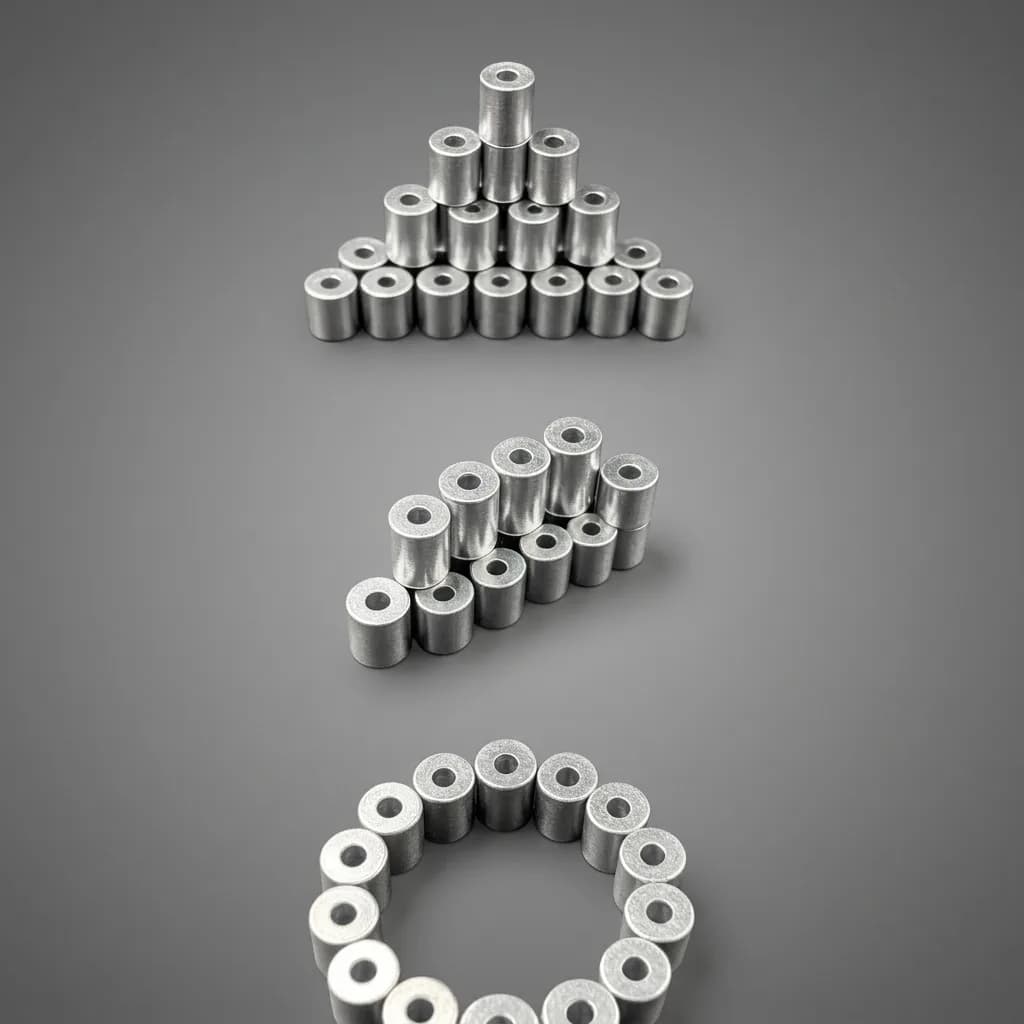
Most high-performance Halbach arrays are custom-engineered. Sourcing success depends heavily on defining correct field topologies, tolerances, and retention methods rather than just buying "strong magnets."
Halbach configurations concentrate flux but also expose segments to high opposing demagnetization fields (self-demagnetization). For hot or high-load-line designs, specify a high-coercivity NdFeB suffix grade or SmCo only after checking irreversible flux-loss margin against the actual geometry.
Evidence: DOE NdFeB supply-chain report, December 2024; supplier grade tables still need project-specific confirmation.
Buying bare magnets for a Halbach rotor is risky. Extremely high repulsive forces during assembly and centrifugal forces during operation necessitate professional bonding, balancing, and carbon-fiber or titanium sleeves.
Purchasing a Halbach array is an engineering procurement task. Understanding the manufacturing steps ensures your supplier can actually deliver the theoretical performance promised by simulation.
Theoretical Halbach arrays assume perfect magnetization vectors. In reality, purchasing specifications must account for:
When you buy a Halbach assembly, a significant portion of the cost is not the NdFeB material, but the labor and tooling needed to build it safely:
Fig 1. Treat these as quote line items, not universal market percentages. Prototype tooling can dominate the first order, while volume runs shift more cost back to material and QA controls.
The configurator narrows the starting point, but the purchase decision should be frozen only after the supplier explains grade, temperature, coating, and demagnetization margin in one review.
| Buying scenario | Starting material path | Must confirm | Main risk |
|---|---|---|---|
| Room-temperature prototype | N45-N52 NdFeB | Coating, actual working gap, and demagnetization margin. | Highest Br grade can lose margin if the load line or heat rise is ignored. |
| High field near 1 T or above | N50M/N48H class or reviewed high-coercivity NdFeB | FEA, pole pitch, back iron, and irreversible flux-loss limit. | Buying only by surface field can miss self-demagnetization inside the array. |
| Above 120 C or thermal cycling | SH/UH/EH/AH NdFeB or SmCo after load-line review | Max temperature, duty cycle, grade suffix, and test method. | Catalog max operating temperature is not a universal design guarantee. |
| Vacuum / UHV | Low-outgassing coating and adhesive stack, sometimes SmCo | Coating, cleaning, bake-out, and outgassing limits. | Standard plated assemblies can fail contamination or adhesion requirements. |
Public grade labels are screening data. A quote-ready material decision should include the magnet grade suffix, demagnetization curve review, coating choice, and acceptance test for the actual Halbach geometry.
These references do not replace supplier validation, but they anchor the buying advice to traceable material, balancing, and measurement sources.
A strong supplier should turn your buying intent into a controlled engineering sequence rather than quoting loose magnets first.
Buyer action: State field strength, working gap, field uniformity, and allowed leakage.
Supplier proof: Analytical estimate plus 2D/3D FEA before tooling.
Buyer action: Provide STEP/drawing, segment count, bore/OD, length, and datum scheme.
Supplier proof: Tolerance stack review, fixture concept, and measurement plan.
Buyer action: State temperature, RPM, coating, adhesive, sleeve, and safety constraints.
Supplier proof: Grade/load-line check, sleeve stress review, and bond process controls.
Buyer action: Define sample approval: field map, balance report, inspection report, photos.
Supplier proof: Outgoing inspection report and corrective action path for deviations.
The main failure modes are predictable: unsafe assembly, under-scoped quote costs, wrong material grade, and weak acceptance evidence.
| Risk type | Common trigger | Minimum mitigation |
|---|---|---|
| Misuse risk | Buying loose magnets and assembling a rotor without fixtures. | Request bonded assembly, sleeve design, dynamic balancing, and handling notes. |
| Cost risk | Treating custom Halbach arrays as catalog magnet purchases. | Separate NRE tooling, sample QA, material, coating, and volume pricing in the quote. |
| Scenario mismatch | Selecting N52 for high-temperature or high-demagnetization load lines. | Ask for grade suffix rationale and irreversible flux-loss criteria before PO. |
| Evidence gap | Supplier promises field strength but cannot supply measured maps. | Make measured field map, harmonic analysis, or agreed inspection records part of acceptance. |
Not all magnet suppliers are equipped to manufacture Halbach arrays. Use this criteria to qualify your manufacturer before issuing a PO.
| Capability | Why it matters | What to ask the supplier |
|---|---|---|
| In-House FEA Simulation | Ensures the manufacturer understands your field targets and demagnetization risks. | "Can you verify our nominal field strength with a 3D FEA report before tooling?" |
| Custom Tooling Design | Halbach segments repel violently. Poor fixturing leads to chipped magnets and dangerous assemblies. | "How do you plan to fixture and bond these specific segment angles safely?" |
| Precision Measurement | You cannot verify gradient quality without a multi-axis Gauss meter or field mapper. | "Will you provide a field map or harmonic analysis report with the final parts?" |
| High-Speed Balancing & Retention | Rotor arrays need dynamic balancing and a reviewed retention method to survive high RPM and centrifugal forces. | "Do you provide carbon-fiber, titanium, or Inconel sleeves? Can you certify the balance quality grade under ISO 21940-11, with legacy ISO 1940-1 G2.5 wording only if the customer specification still uses it?" |
Define topology, field target, working gap, operating temperature, coating, retention method, quantity, and acceptance evidence. For rotors, include RPM, sleeve material, and balance grade.
Some simple linear demonstrators exist off the shelf, but high-performance cylinders, rotors, and precision field assemblies are usually custom because geometry, grade, retention, and measurement criteria drive performance.
Start from NdFeB for high flux at moderate temperatures, then move to high-coercivity NdFeB suffix grades or SmCo when temperature, vacuum, or demagnetization margin requires it. Confirm against the actual load line.
Cost depends on magnet volume, segment geometry, coating, fixture NRE, assembly labor, balancing, and measured QA. Treat any early figure as a budget range until CAD and acceptance tests are frozen.
Include STEP or drawings, target field map, tolerance scheme, temperature range, duty cycle, coating, quantity, inspection report needs, and whether you need simulation, bonded assembly, or only magnet segments.
Use FEA when the design is short, segmented, near steel, high field, curved, thermally stressed, or acceptance depends on homogeneity. Simple analytical estimates are useful for screening, not final acceptance.
Halbach segments repel during assembly, and rotor magnets see centrifugal loads in service. Adhesive, sleeve, and balance choices determine whether the array remains mechanically safe.
Ask for measured field maps, dimensional inspection, magnetization or polarity checks, balance records for rotors, and a nonconformance path if the field differs from the model.
If you are ready to move forward, review our manufacturing limits or explore our product lines before submitting an RFQ.
Send us your RFQ requirements (from the configurator above) along with your STEP files. Our engineering team will review manufacturability and provide a quote.
Inquiry Email
